

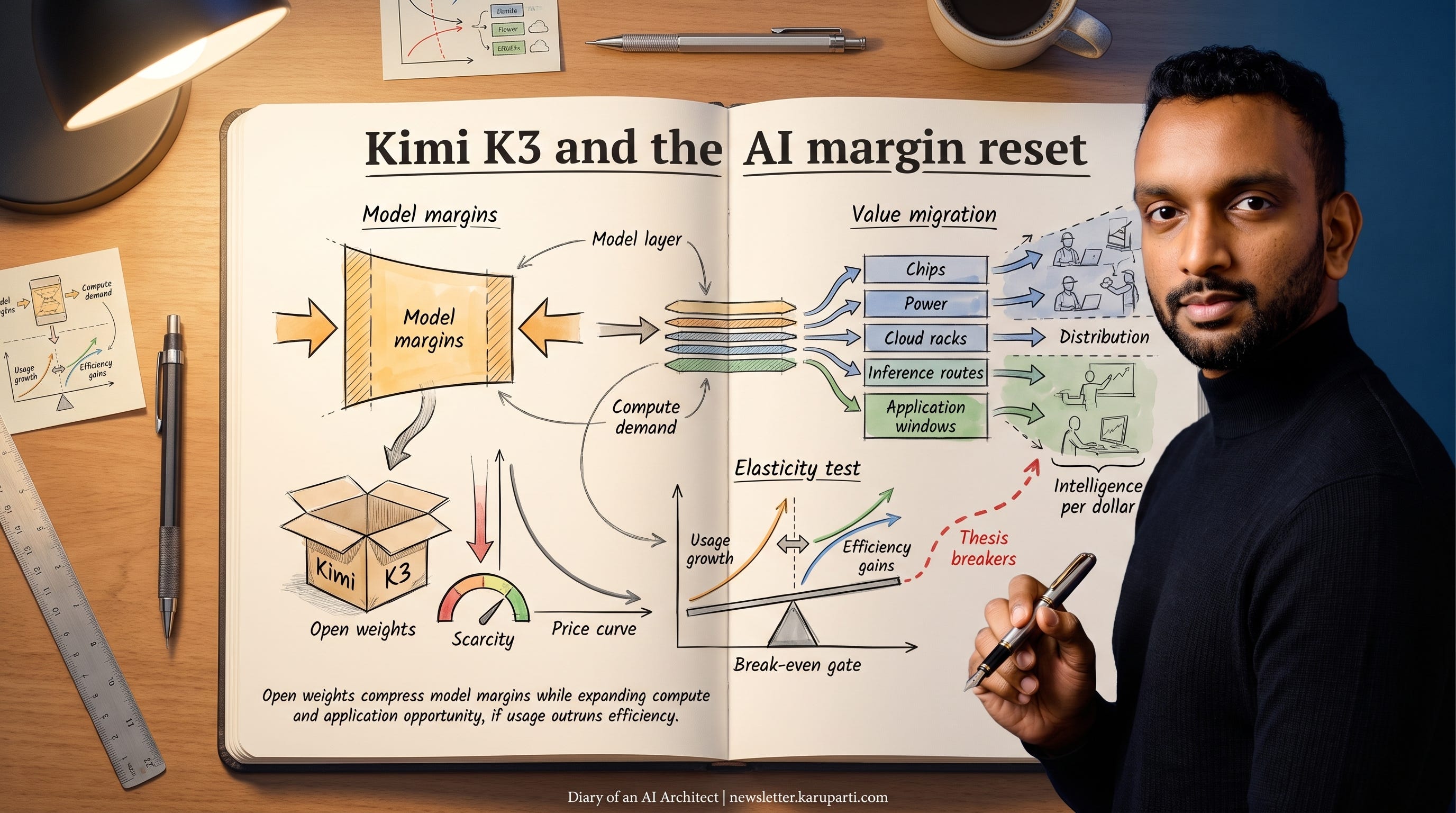
The most important question about Kimi K3 is not whether it beats the best closed model. It is what happens to the rest of the AI economy when frontier-level intelligence becomes easier to download, customize, and distribute.
That question is the starting point for Part 2 of my Kimi K3 analysis.
In Part 1, I wrote from a builder/architect’s perspective. I explained why architects should pay attention to Kimi K3 and how open-weight models change the way we design AI systems.
This time, I am looking at the same shift as an investor.
That is different from my usual technical deep dives. Promise that I will have more technical deep dives in the coming days.
I also invest across the AI ecosystem, and use my technical background to understand which trends could create durable businesses, which could compress margins, and where value might move next. Below is my analysis, not investment advice.
One post from investor Gavin Baker made me stop and think. I read it several times because it offered a useful explanation for the market’s reaction to K3. His argument was that open-weight models could pressure the economics of leading closed-model companies while benefiting much of the surrounding AI stack.
That leads to the bigger question now worrying Wall Street:
If intelligence becomes cheaper, are the enormous investments in chips, power, data centers, and cloud infrastructure still justified?
To answer that, we first need to understand two competing strategies in the global AI race.
Leading US frontier labs such as OpenAI and Anthropic primarily monetize access to proprietary models.
Chinese labs such as Moonshot, DeepSeek, Qwen, and Z.ai increasingly use open-weight releases to win distribution, attract developers, and accelerate ecosystem adoption.
This is not a perfect US-versus-China divide. Both countries have open and closed models. But their current centers of gravity are different.
We have seen versions of this competition before: proprietary operating systems versus Linux, iOS versus Android, and closed platforms versus open ecosystems.
Open alternatives do not necessarily destroy proprietary products. Android did not eliminate iOS, and Linux did not eliminate commercial operating systems.
But they changed pricing power, distribution, and where profits accumulated.
That is the question I want to explore:
If open weights compress margins at the model layer, does economic value disappear, or does it migrate toward chips, clouds, inference platforms, and applications? And why is Nvidia betting on the second outcome?
Moonshot AI released K3’s full weights on July 27 under a custom license. The model has 2.8 trillion total parameters, activates 104 billion per token, and supports a one-million-token context window [1]. Its official Hugging Face checkpoint recorded more than 1.1 million downloads in the last month as of August 4 [2].
K3 is not free compute. Moonshot recommends supernode configurations with 64 or more accelerators for deployment [1]. What became freely obtainable was the model artifact. The expensive work of serving it moved elsewhere.
That distinction is the investment story.
The Story…
Rina is a portfolio manager covering AI infrastructure and software. On Monday morning, her team puts two charts on the screen.
The first shows K3’s release and the sharp declines in two Chinese AI competitors. Reuters reported that Zhipu and MiniMax shares were down 27.7% and 16.5%, respectively, near the close on launch day [3]. The second shows the familiar AI stack: power, accelerators, networking, clouds, model labs, and applications.
Her analyst asks the obvious question: “If models become cheaper and more open, is that bearish for the companies funding the compute buildout?”
The answer depends on which layer you are analyzing.
Cheaper intelligence can hurt a company whose advantage is scarcity at the model layer. The same price decline can help an application company that now buys more capability for every dollar.
It can help an inference provider that serves many open models. It can help a chip vendor if lower prices unlock enough additional workloads.
One event can be deflationary for one layer and expansionary for another.
The five-layer value migration map
I use a five-layer framework to analyze this shift:
Model margins: Does open competition reduce scarcity and pricing power?
Compute volume: Does cheaper intelligence create enough new usage to offset efficiency?
Distribution power: Which model ecosystem becomes the default starting point for builders?
Value capture: Which infrastructure and application layers gain leverage?
Thesis breakers: What evidence would prove the bullish interpretation wrong?
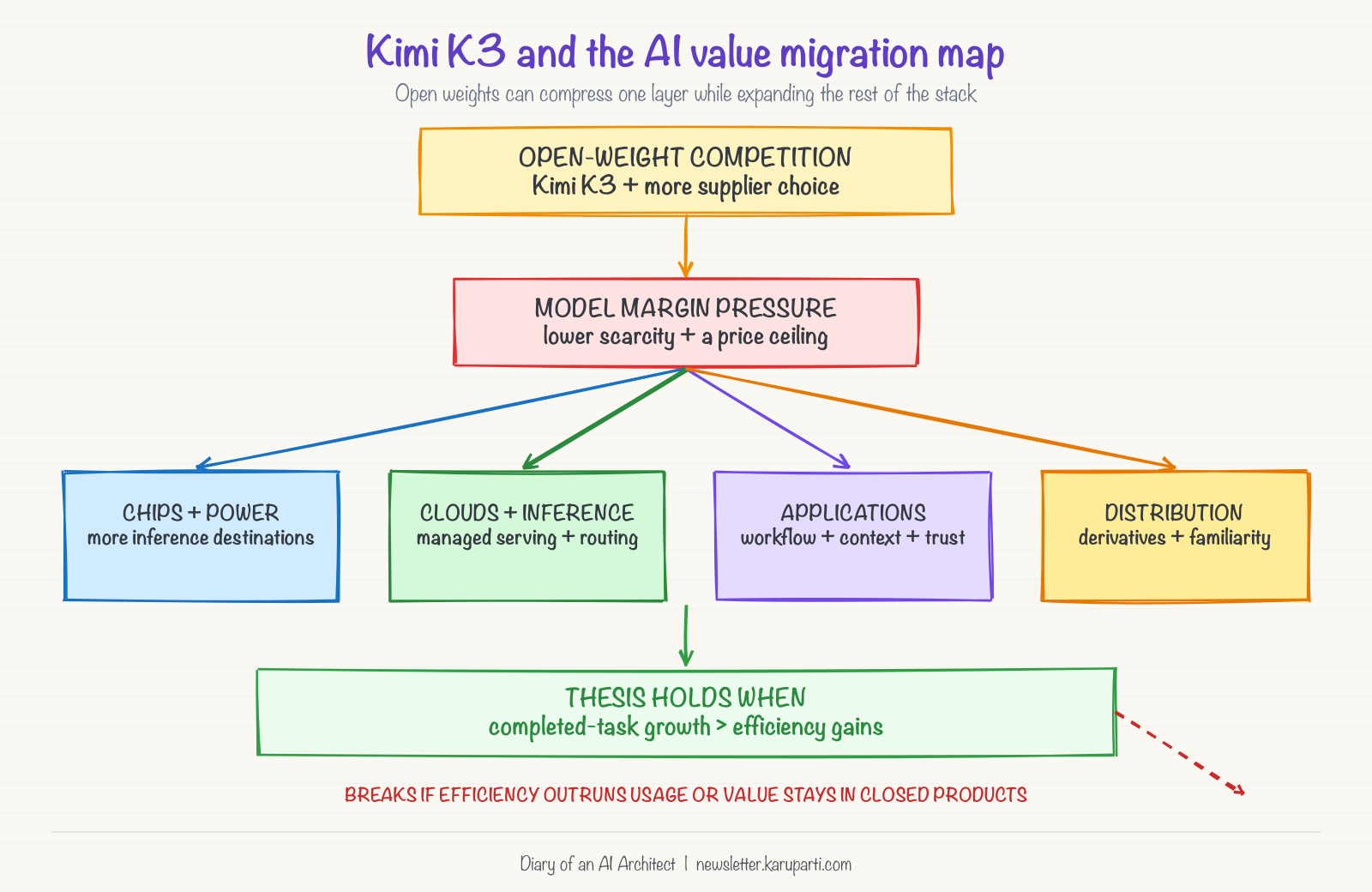
This is not a forecast for any individual stock. It is a way to reason about how one technical shift can change the economics of the whole stack.
Layer 1: Model margins face a new ceiling
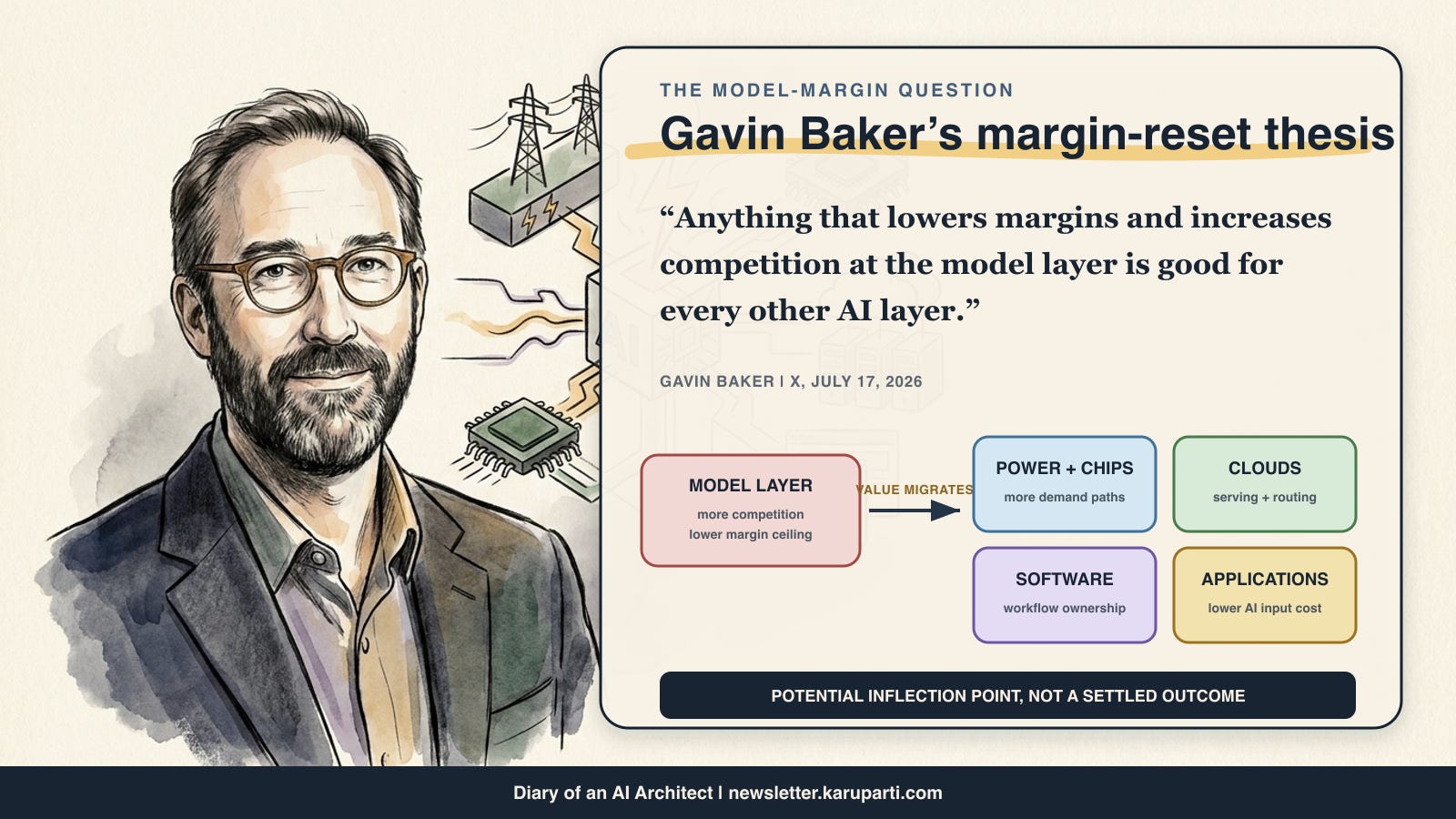
Investor Gavin Baker captured the sharpest version of the argument in a July 17 post. He called K3 a potential inflection point that could be negative for Anthropic and OpenAI while benefiting almost every other company [4]
His hypothetical is a world where two or three frontier labs sustain 90% inference margins. In that world, those labs gain extraordinary bargaining power over power suppliers, data centers, semiconductor vendors, hyperscalers, and application companies. They can also integrate downward into infrastructure and upward into software.
Open models put a ceiling on that scenario. If a credible alternative can be downloaded, modified, and served by several providers, the model layer becomes harder to monopolize. Customers gain a fallback. Inference companies gain inventory. Application builders gain negotiating leverage.
K3 does not prove proprietary models lose. Baker explicitly says the threat is only potential. Product experience, agent harnesses, reliability, and stronger internal checkpoints may protect the leading closed labs [4]. A weight file is not a complete product.
K3’s weights are available to download, modify, and deploy, including for many commercial uses. But the license adds conditions for companies operating model-as-a-service businesses and for products above certain scale thresholds. Large model-hosting businesses may need a separate agreement with Moonshot, while very large products may need to display Kimi K3 attribution [5].
In other words, the weights are open, but the commercial license is not unrestricted. That is why I call K3 an open-weight model, not unconditionally open-source software.
Layer 2: Jensen Huang is betting on elasticity
Nvidia CEO Jensen Huang’s response to K3 was unusually direct. “Free AI should be great for hardware. Free AI should be great for chips. Free AI should be great for data centers,” he told Axios [6].

That is an elasticity argument.
If the price of useful intelligence falls, more developers experiment, more companies deploy, and existing applications call models more often. Each model invocation still requires compute somewhere, even when the weights cost nothing to acquire.
The arithmetic is simple. Total inference demand depends on three moving variables:
# Illustrative example.
task_growth = 4.0              # Companies run four times as many AI tasks.
tokens_per_task = 0.60         # Each task uses 40% fewer tokens.
compute_per_token = 0.80       # Each token needs 20% less compute.

new_compute_demand = task_growth * tokens_per_task * compute_per_token
print(new_compute_demand)      # 1.92x the original compute demand
Start with 100 units of compute demand. Running four times as many tasks would raise demand to 400 units. Using 40% fewer tokens per task reduces it to 240 units, and using 20% less compute per token reduces it again to 192 units.
The final result is still 192 units versus the original 100, so total compute demand rises 92%. Usage grew faster than the combined efficiency gains.
That break-even point is the entire Nvidia debate. In this example, each task needs only 48% as much compute as before. Therefore, companies must run slightly more than twice as many tasks, about 2.1 times as many, before total compute demand increases.
If the above math doesn’t make sense, please see below
Before:

1,000 tokens per task
× 1 compute unit per token
= 1,000 compute units per task

After:

600 tokens per task
× 0.8 compute units per token
= 480 compute units per task

480 / 1,000 = 48%

So each task is 52% cheaper in compute terms.

If companies run 4× as many tasks:

4 × 48% = 192%

So total compute consumption becomes 1.92× the original amount, even though every individual task became dramatically more efficient.

The break-even point is:

1 ÷ 0.48 = 2.08×

So:

Below ~2.08× task growth → total compute demand falls.
At ~2.08× task growth → compute demand stays roughly flat.
Above ~2.08× task growth → total compute demand rises.
K3 itself is not yet the clean proof. Baker’s caveat is that K3 is less token efficient than leading closed alternatives on Artificial Analysis data, so the true “Sputnik moment” would be an open frontier model that also leads on intelligence per dollar [4].
A computationally hungry open model may increase infrastructure demand, but customers ultimately optimize for completed work, not raw tokens.
Layer 3: Distribution is becoming strategic power
China’s open-weight strategy is not only about model revenue. It is also about becoming the foundation other people build on.
Hugging Face reported that Chinese models accounted for 41% of downloads over the prior year, the largest national share on its platform [7]. The report also found that Qwen had more than 113,000 derivative models using it as a base, and more than 200,000 repositories tagging Qwen [7].
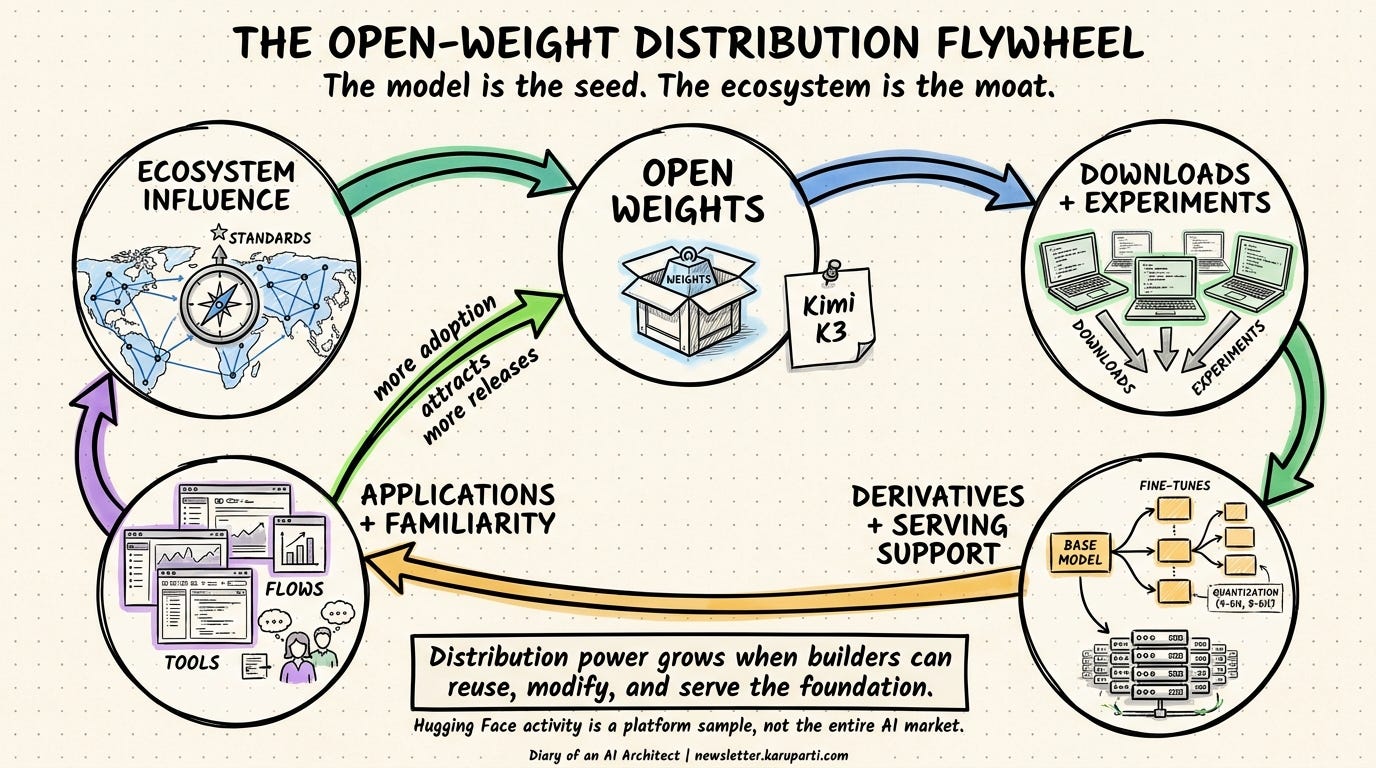
Those numbers are platform-specific, not a measure of the entire AI market. They still reveal a powerful distribution flywheel:
Open weights
  -> more downloads and experiments
  -> more fine-tunes, quantizations, and serving support
  -> lower adoption friction
  -> more applications and developer familiarity
  -> stronger ecosystem influence
The contrast with the dominant US frontier strategy is useful, but it is not a clean national binary. OpenAI and Anthropic emphasize proprietary frontier services. China has made frequent open releases from DeepSeek, Qwen, Z.ai, MiniMax, and Moonshot a competitive norm. At the same time, the US has open efforts such as GPT-OSS, Gemma, Llama, and Nvidia’s Nemotron, while Chinese companies also sell closed products and APIs.
The strategic difference is emphasis. Many US frontier companies monetize scarce access to their best systems. Chinese labs are increasingly using open artifacts to win distribution, accelerate derivatives, support domestic hardware, and pull developers into their ecosystems [7][8].
Stanford’s 2026 AI Index says the US-China model performance gap had narrowed to 2.7% as of March, even as the US retained advantages in top-tier model production and private investment [9]. When capability gaps shrink, distribution matters more.
Layer 4: Value does not disappear, it moves
Vercel’s June production data offers an early picture of that migration. Open-weight models ran 29% of tokens through its AI Gateway on less than 4% of spend. Meanwhile, the top four US frontier labs captured 95% of spend, and Anthropic alone captured 61% of spend on 32% of tokens [10].
This is one gateway’s routing data, not the whole market. But it supports a two-tier structure already forming in production:
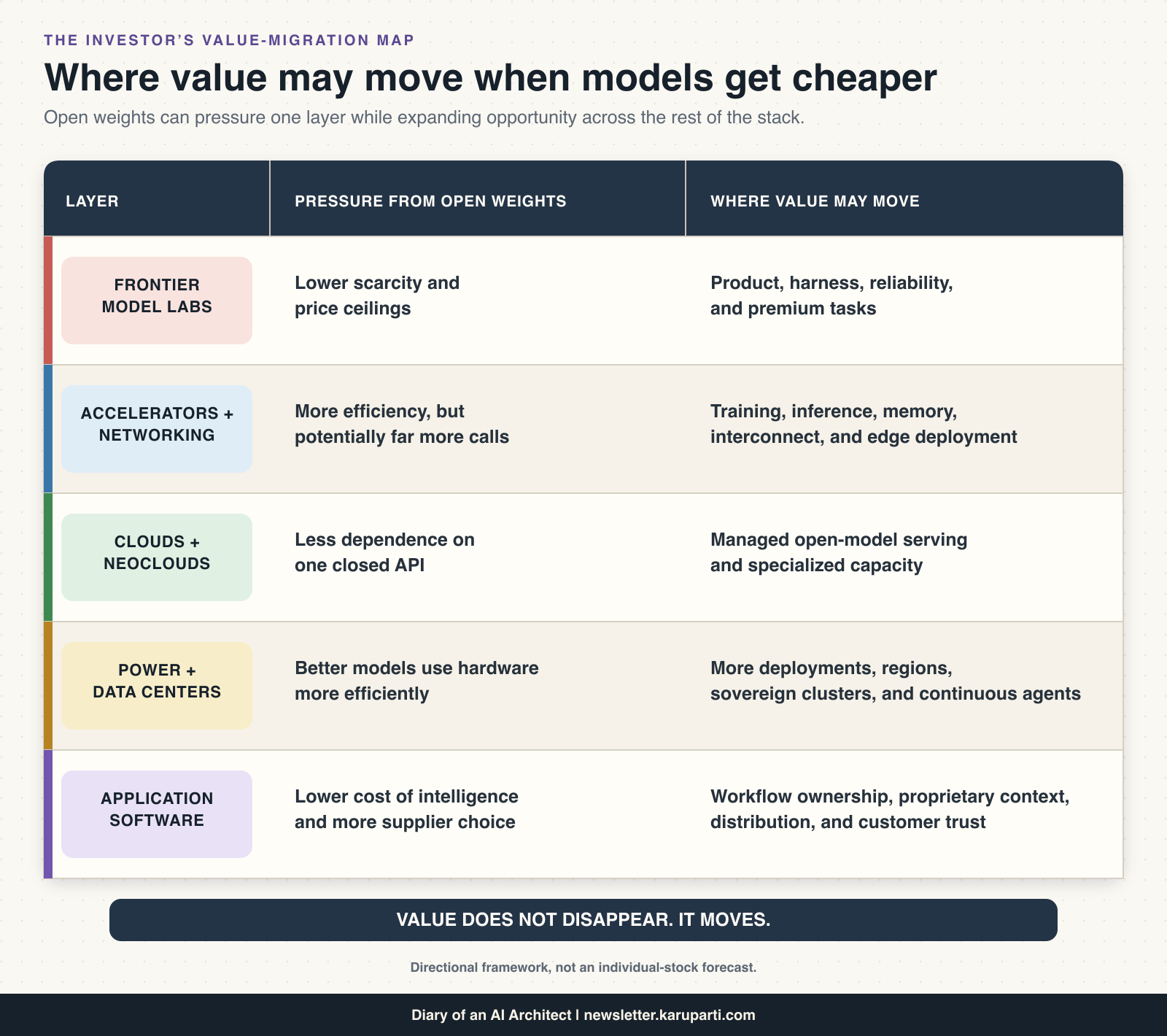
The strongest application companies may treat models the way modern software treats databases. The underlying engine matters, but customer value lives in workflow design, proprietary context, evaluation, permissions, integration, and distribution.
Nvidia is already acting on this thesis. Its Nemotron program publishes open weights, training data, and recipes. Its Nemotron Coalition is building an open frontier model on Nvidia infrastructure, and Nvidia says open models create more startups, more builders, and lower entry barriers [11][12].
There is a counter-risk for Nvidia. Chinese labs are also optimizing models for Huawei Ascend, Cambricon, and other domestic accelerators, while open software is reducing dependence on CUDA-specific deployment paths [8]. Open-model growth can expand global compute demand without guaranteeing that every new dollar lands on Nvidia hardware.
That nuance makes Huang’s position more interesting, not less. He is defending an expanding market while competing to keep Nvidia at the center of it.
Layer 5: What would break the thesis
A serious investment framework needs disconfirming evidence. I would watch five failure modes.
Efficiency outruns usage. If task volume grows slower than reductions in tokens per task and compute per token, total accelerator demand falls.
Products remain the moat. If users consistently pay for ChatGPT, Claude, and their agent harnesses regardless of model availability, value stays with closed platforms.
Open models fail high-stakes work. Vercel found that expensive, consequential workloads still concentrated in frontier closed models [10]. If that persists, open weights own volume but not profit pools.
Policy restricts distribution. Security reviews, sanctions, procurement rules, or data-governance concerns could slow adoption of Chinese weights in Western enterprises.
Alternative silicon captures the growth. If the Chinese open ecosystem increasingly trains and serves on domestic accelerators (compute), the open-model boom may weaken Nvidia’s geographic share even while total compute expands.
I would add one more operating test: cost per accepted result. Open weights win economically only when inference, retries, latency, engineering, governance, and human correction together beat the alternative. A low token price is not enough.
The bottom line
Kimi K3 is not proof that open models win every workload or that proprietary labs lose their businesses. It is evidence that frontier intelligence is becoming more contestable, and contestability changes who holds leverage across the stack.
The opportunity is not simply in owning the smartest model. It is in understanding where value moves when intelligence gets cheaper.
♻️ If this was useful, share it with someone building with AI.
✉️ Subscribe at newsletter.karuparti.com so you never miss an edition.
P.S. Want more? 👋
1/ My visual guide to agentic AI → Gumroad
2/ Daily deep dives on agentic AI architecture → LinkedIn
3/ Real-time takes on breaking AI news → X
4/ Casual hot takes and community → Threads
5/ Visual frameworks and carousels → Instagram
6/ 60-second production lessons → TikTok
7/ The full newsletter, free → newsletter.karuparti.com
References
Kimi K3: Open Frontier Intelligence - Moonshot AI
Kimi K3 model card and usage data - Moonshot AI and Hugging Face
China’s Moonshot unveils world’s largest open AI model - Reuters
Kimi K3 License - Moonshot AI
Nvidia’s Jensen Huang defends Chinese AI amid Kimi panic - Axios
State of Open Source on Hugging Face: Spring 2026 - Hugging Face
On the Shifting Global Compute Landscape - Hugging Face
The 2026 AI Index Report - Stanford HAI
NVIDIA Nemotron - Nvidia

Anu Karuparti Creator, Diary of an AI Architect How enterprises actually ship AI to production
Read by 3,000+ FDEs, AI Architects, and Engineering Leaders from Microsoft, Google, IBM, PwC and others.
Connect with me on LinkedIn.
Want to partner? Email me at anurag.karuparti@gmail.com.
Investment note: This article is an educational analysis of AI industry economics, not investment advice or a recommendation to buy or sell any security.
Disclaimer: The stories and scenarios in this article are hypothetical, inspired by patterns observed across similar real-world experiences. They are used to convey key concepts more effectively and do not represent any specific individual or organization.