

A frontier-class model is about to become downloadable. The biggest opportunity is not switching models. It is redesigning your AI architecture to take advantage of what comes next.

This week in my diary, I am working through a question I expect more AI architects to face: when should an enterprise use an open-weight model, and when is a closed model still the better architectural choice? And does Kimi K3 makes that question urgent.
Moonshot AI introduced Kimi K3, a 2.8-trillion-parameter model with native multimodality and a one-million-token context window.
Moonshot calls it the first open 3T-class model and says the full weights will be released by July 27, 20261. As I publish this on July 24, K3 is available through Kimi’s products and API, but the full weights are not yet downloadable.
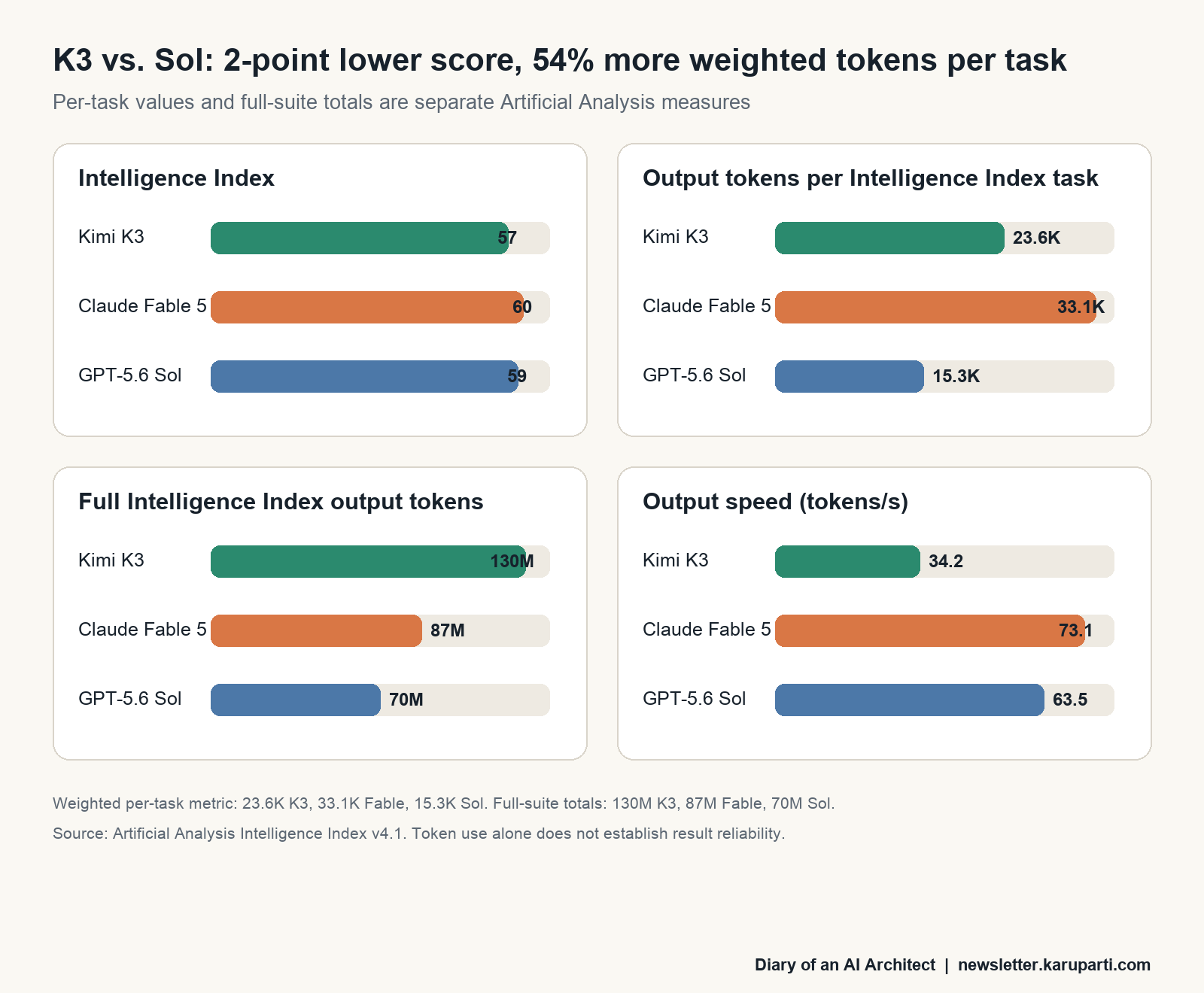
The timing matters because K3 is not a small open model nibbling at the edges. It scores 57 on the Artificial Analysis Intelligence Index, three points behind Claude Fable 5 at 60 and two behind GPT-5.6 Sol at 59 [3][4][5]. Reuters also reported that Arena.ai ranked K3 first on its benchmark for building web interfaces at launch [2].
Then the market noticed. Reuters reported that shares of Chinese AI competitors Zhipu and MiniMax fell 27.7% and 16.5%, respectively, after the announcement [2]. I would not claim that K3 caused every wobble in US technology stocks, but those moves show that investors understood the threat: frontier capability may no longer belong only to labs that keep their best models behind an API.
I am not writing this from a geopolitical angle. I am writing it from a builder and architect’s angle: what does a competitive open-weights model like Kimi K3 actually mean for your AI solutions, and how do you get ahead of it.
Not whether open weights beat closed models everywhere, but how you build agents and orchestration that really harness this shift instead of getting caught flat-footed by it.
The framework: design for model optionality
Reflex: hardwire the newest model into every agent
  -> optimize for one leaderboard
  -> inherit one vendor's economics and constraints
  -> migrate the whole system when the frontier moves

Fix: separate orchestration from model execution
  -> classify the workload's constraint
  -> route it to open or closed execution
  -> measure quality, latency, and cost per completed task
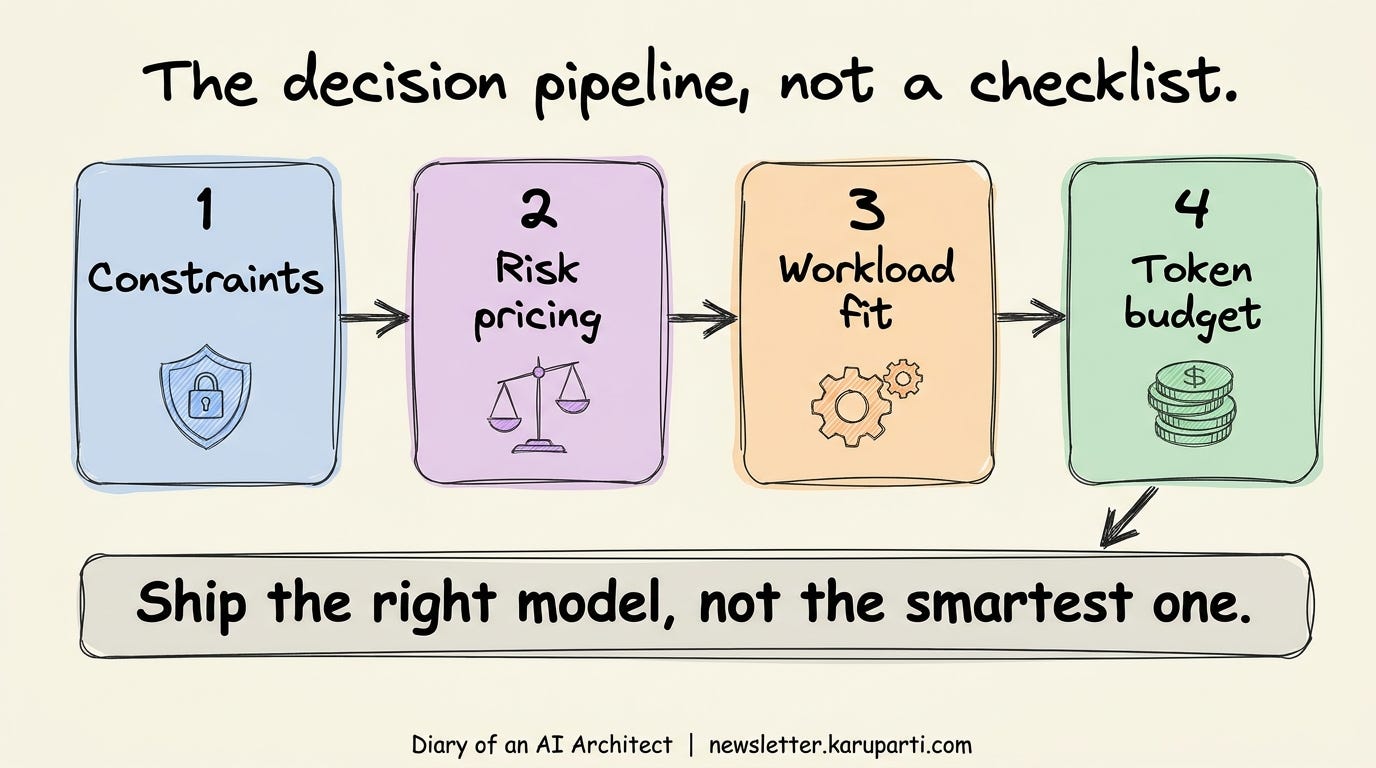
The reflex is understandable. Leaderboards are legible and screenshots travel fast. But a model is one component in an agent system, not the architecture itself. Here are the four questions I would ask before adding K3 to an enterprise model portfolio:
Move 1: Identify the constraint that open weights remove.
Move 2: Decide which control you are willing to own.
Move 3: Route workloads instead of choosing one winner.
Move 4: Measure economics per completed task.
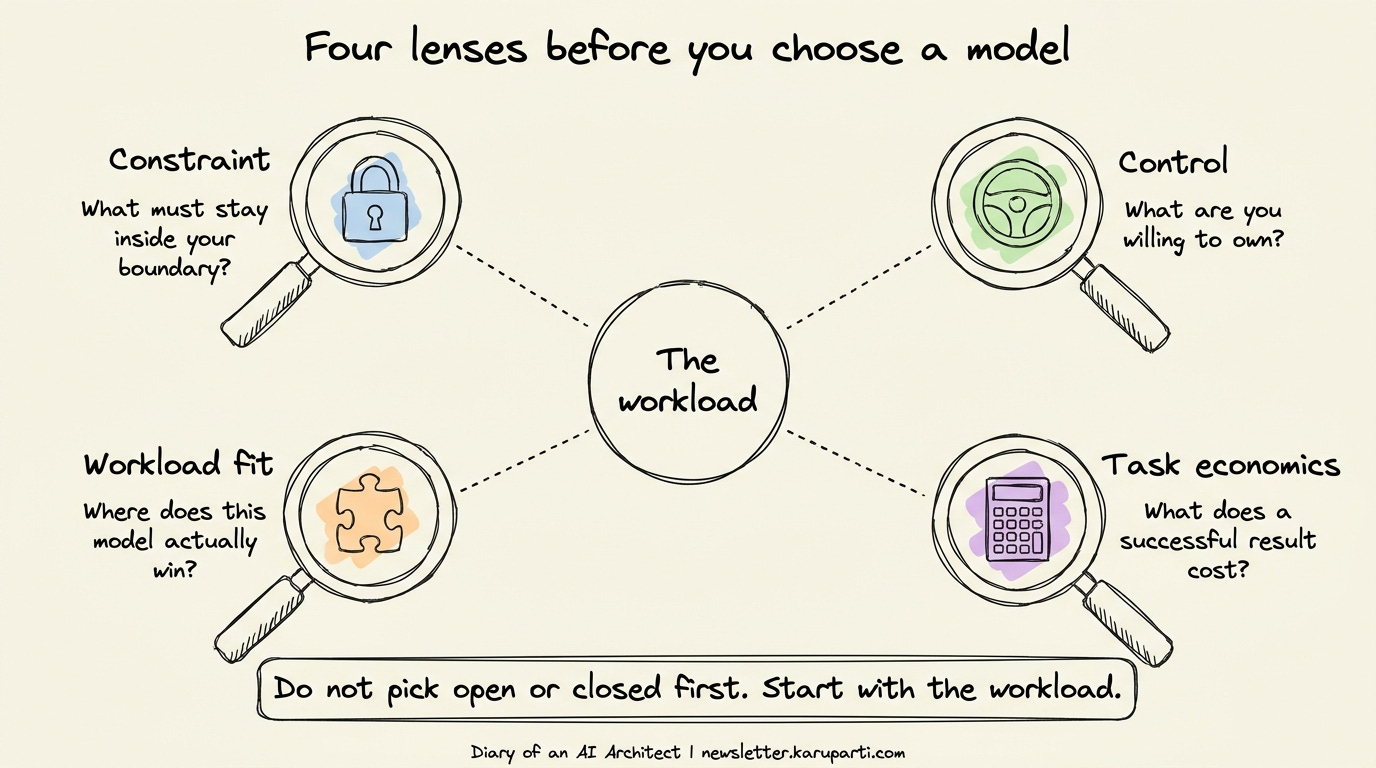
Move 1: Identify the constraint that open weights remove
Open weights are valuable when they remove a real constraint. They let you deploy inside a controlled environment, adapt the model, inspect artifacts, choose an inference provider, and avoid making one API the permanent center of your system. Chinese labs are gaining influence through this strategy, with MIT Technology Review reporting that Chinese open-weight models narrowly surpassed US models in global downloads over the year ending August 2025 [7].
For most teams, the constraint is data residency. The compliance team cares more about whether patient data leaves an approved boundary than a three-point benchmark gap. For some team, the constraint may be customization, offline operation, regional availability, or leverage in a vendor negotiation.
Open weights do not automatically mean easy self-hosting. Reuters noted that K3’s scale means few users are likely to host it themselves, and Moonshot recommends supernode configurations with 64 or more accelerators [1][2]. For many teams, “open” will mean using a managed inference partner while retaining the option to move, not putting K3 under someone’s desk.
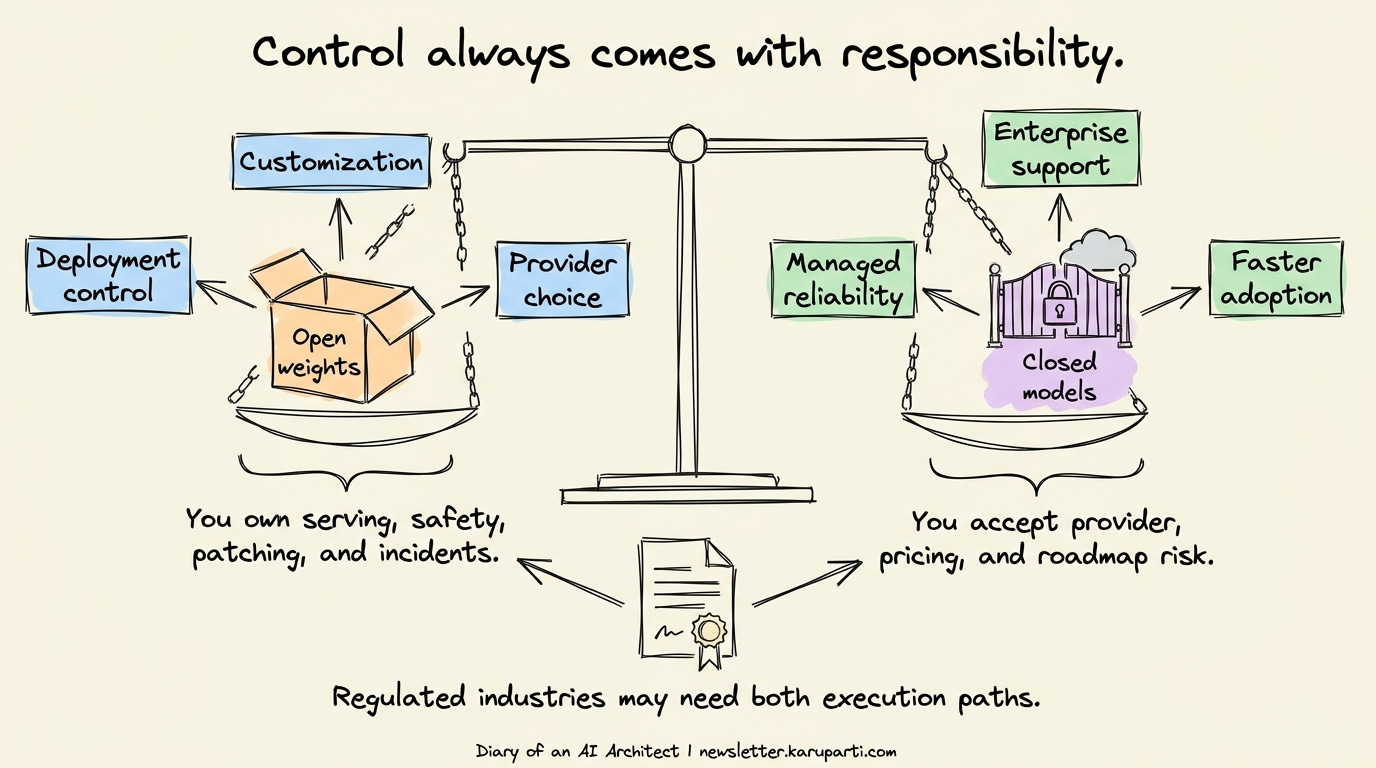
Move 2: Decide which control you are willing to own
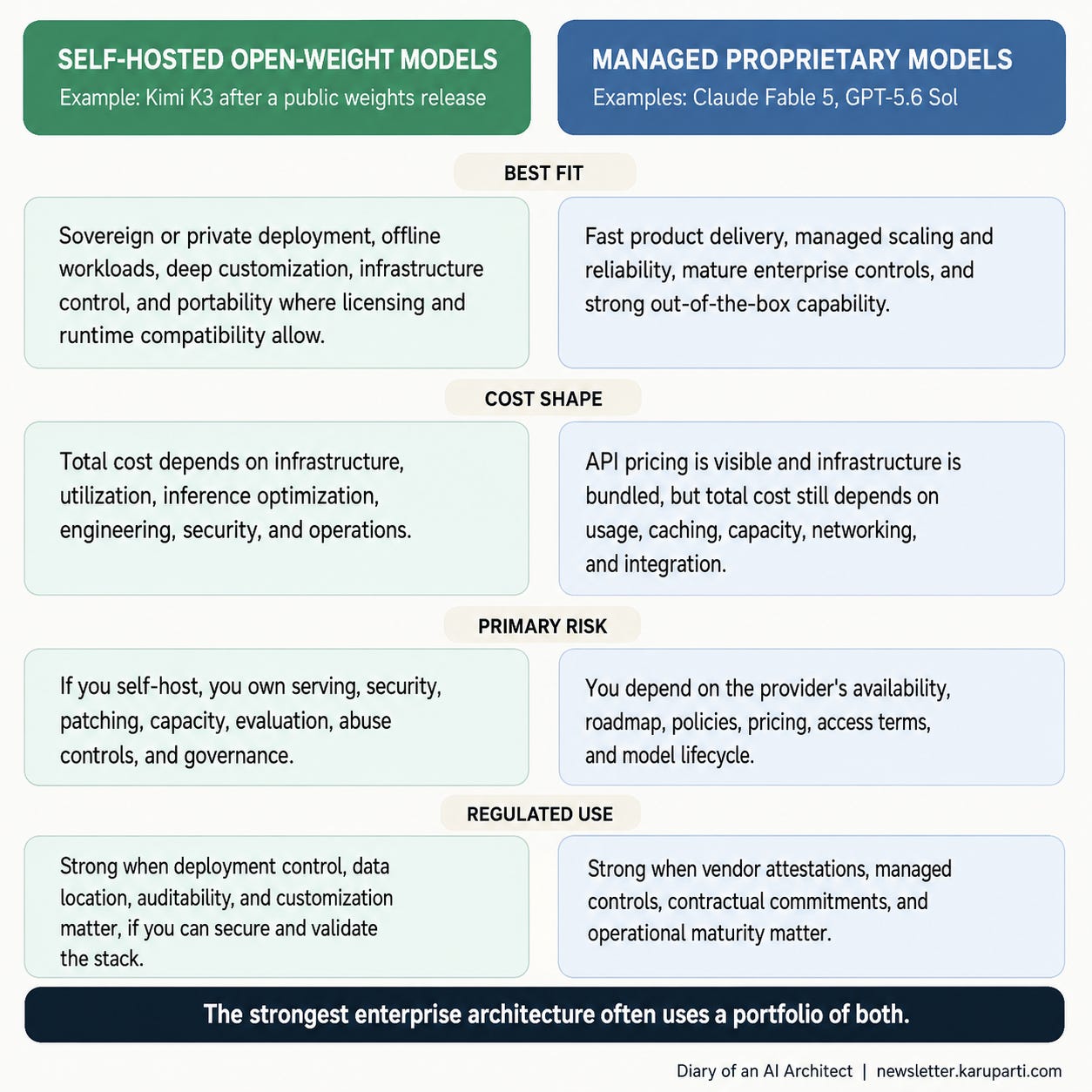
Open weights exchange vendor control for operator responsibility. You gain deployment and adaptation control, but you also own serving reliability, capacity planning, model patching, evaluation, safety controls, and incident response. Downloading weights is free. Operating frontier inference is not.
Closed models make a different trade. You give the provider more control over the model, roadmap, pricing, and availability. In return, enterprise contracts can provide service commitments, certifications, abuse monitoring, support, and a clearer party to hold accountable.
Heavily regulated industries do not universally prefer one side. A bank may prefer open weights for sovereign deployment and closed models for workloads where vendor assurance and indemnification matter more. The architecture should let policy choose the execution path at runtime.
K3 adds two model-specific risks. Moonshot says it can become unstable if an agent harness does not preserve its thinking history, and that its long-horizon training can make it excessively proactive on ambiguous tasks [1]. Those are not reasons to reject it. They are reasons to test harness compatibility and enforce explicit action boundaries before production.
The chart shows why routing matters. K3 sits close to the intelligence frontier, but its serving profile differs materially from the two closed models.
Move 3: Route workloads instead of choosing one winner
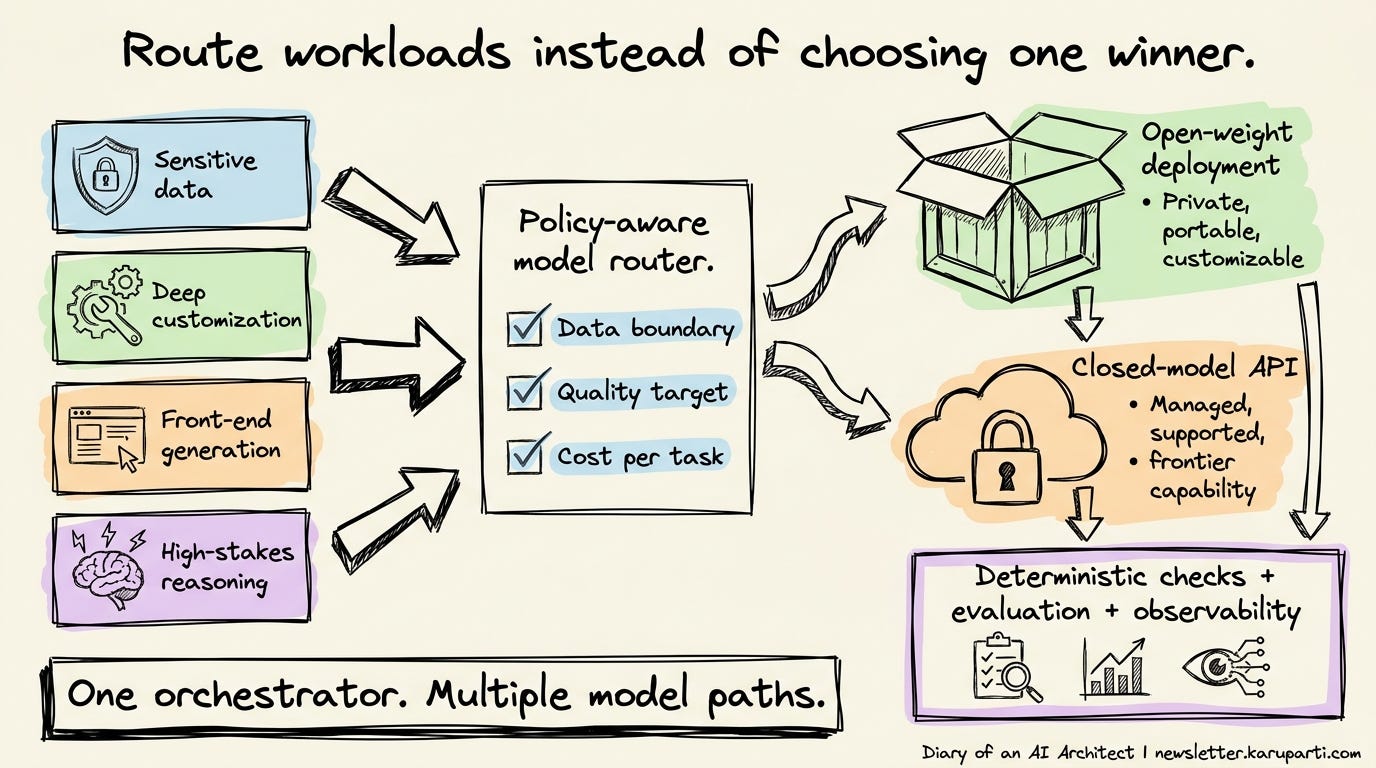
The winning design is often a portfolio. Put a policy-aware model router behind a stable orchestration contract.
Send sensitive, customizable, or offline tasks toward an approved open-weight deployment.
Send high-stakes tasks that need maximum capability or contractual assurance toward a closed provider. Keep deterministic checks outside both models.
K3’s web-interface result makes it especially interesting for visual coding agents, front-end prototyping, long-horizon engineering, and multimodal creation. Reuters reported that it ranked first on Arena.ai’s web-interface benchmark at launch [2]. That does not make it the automatic choice for every coding agent, but it earns a place in the evaluation set.
Move 4: Measure economics per completed task
Here is K3’s caveat. On the Artificial Analysis Intelligence Index v4.1 evaluation, K3 generated 130 million output tokens, compared with 87 million for Fable 5 and 70 million for GPT-5.6 Sol [3][4][5][6]. That is 1.86 times GPT-5.6 Sol’s output-token total for the same evaluation suite. K3 was also slower in the reported measurements, at 34.2 output tokens per second versus 73.1 for Fable 5 and 63.5 for GPT-5.6 Sol.
Top AI Investor Gavin Baker called K3 a “token wastrel,” arguing that cost per token hides its higher cost per completed task [8]. The phrase is provocative, but the architecture lesson is sound: do not compare model economics with list price alone.
This does not prove that open-weight models as a category are token inefficient. It proves that this version of K3 used more output tokens on this evaluation.
Your production metric should be cost per successful task, including retries, latency, infrastructure utilization, human review, and failure recovery.
That is the unit-economics discipline I wrote about in my earlier editions on tokenomics and model routing. A cheaper token can still produce a more expensive outcome.
What I will be watching, and how I will architect for it
I will not replace every model call with K3 after July 27. I will add it as a new execution target behind an existing model gateway, then run a controlled evaluation on representative traces. This is the part I am watching most closely: not the leaderboard, but how cleanly K3 slots into an architecture built for optionality.
I would watch five production metrics:
Successful task cost, not token price.
Tokens per accepted result, including retries.
Latency to useful completion, not first-token speed.
Human correction rate, especially for visual coding.
Boundary violations, because proactive agents (open-weight) need tight permissions.
Start with a narrow workload where K3 has a plausible advantage, such as front-end generation from screenshots. Shadow it against the incumbent model. Promote it only when quality and unit economics clear predefined gates.
The bottom line
Kimi K3 is a genuine open-weight frontier challenge, even though the full weights are scheduled for release after this article publishes. Its intelligence and visual-coding results deserve attention. Its scale, harness requirements, and token appetite demand architecture discipline.
Below is a short video I created explaining why AI Builders should pay attention to Kimi K3. If you like my content, I would really appreciate your like, subscribe and comment. Thank you!!
Next week, in Part 2, I want to focus from an economy standpoint: what does an open-weights model like Kimi K3 mean for the entire AI stack? Stanford’s 2026 AI Index says the US-China performance gap has effectively closed, while the US still produces more top-tier models overall [9]. My thesis is that open-weights competition helps spread value across the full stack, chips, power, clouds, inference providers, and application builders, instead of letting a few leading labs with closed frontier models dominate demand. K3 gives us an early test of that thesis.
♻️ If this was useful, share it with someone building with AI.
✉️ Subscribe at newsletter.karuparti.com so you never miss an edition.
Thank you for reading my newsletter!

Anu Karuparti
Creator, Diary of an AI Architect
How enterprises actually ship AI to production
Read by 3,000+ FDEs, AI Architects, and Engineering Leaders from Microsoft, Google, IBM, PwC and others.
Connect with me on LinkedIn.
Want to partner? Email me at anurag.karuparti@gmail.com.
P.S. Want more? 👋
1/ My visual guide to agentic AI → Gumroad
2/ Daily deep dives on agentic AI architecture → LinkedIn
3/ Real-time takes on breaking AI news → X
4/ Casual hot takes and community → Threads
5/ Visual frameworks and carousels → Instagram
6/ 60-second production lessons → TikTok
7/ The full newsletter, free → newsletter.karuparti.com
References
Kimi K3: Open Frontier Intelligence - Moonshot AI
China’s Moonshot unveils world’s largest open AI model, closing in on US rivals - Reuters
Kimi K3: Intelligence, Performance & Price Analysis - Artificial Analysis
Claude Fable 5: Intelligence, Performance & Price Analysis - Artificial Analysis
GPT-5.6 Sol (max): Intelligence, Performance & Price Analysis - Artificial Analysis
Artificial Analysis Intelligence Index methodology - Artificial Analysis
China’s open-source bet - MIT Technology Review
The 2026 AI Index Report - Stanford HAI