

Forward-Deployed Engineer (FDE) is becoming the absolute hottest job in AI right now, and there is a massive reason for it.
I’m an applied AI architect at Microsoft, and I’ve shipped AI agents into Fortune 500 production. I have seen personally how challenging it is to integrate AI into established organizational workflows.
The people actually winning in AI right now are FDEs, because they focus on this exact last-mile integration problem. Companies are drowning in daily AI updates, trying to force them into their existing workflows with years of messy data.
So what is the role of an FDE, and why are they suddenly commanding half-a-million-dollar salaries?
The Origin: Who Coined the Term?
The FDE isn’t new. Palantir coined “forward-deployed engineer” more than fifteen years ago. By 2009 the company already had around 120 forward-deployed engineers sitting inside customer sites, wiring messy government and bank data into something usable.
The role was modeled after high-end French restaurant kitchens, where the front-of-house staff is deeply integrated with the chefs and empowered to tell the customer when they are ordering wrong.
The idea was radical for its time: don’t ship software over the wall and hope. Send your best engineers to live next to the customer, watch them struggle, and bend the product to reality.
Palantir’s CTO Shyam Sankar has spent years evangelizing this model, and the “Palantir mafia” carried it into the next generation of startups.
Now the rest of the industry has caught up. In 2025, OpenAI publicly posted Forward-Deployed Engineer roles to help enterprises actually deploy GPT-class systems. Anthropic, Sierra, and a wave of AI startups followed.
The reason is simple: in the generative AI era, the bottleneck moved. It’s no longer “can we build a capable model?” It’s “can we make this model create real value inside one specific, messy organization?”
Why is it such a challenging job?
An FDE is part engineer, part consultant. They sit directly next to the customer and make the AI actually work in the real world.
Technical mastery is just the baseline. The real superpower is problem-solving under massive ambiguity. You have to understand both the code and the business, bridging the gap between internal engineering teams and the end user, and adapting software to real-world constraints like legacy security protocols, fragmented data, and executive politics.
Because of that, three things make FDEs worth a fortune:
They live in the problem. They watch real users hit real failures, so they build for what is actually breaking, not what looks good in a demo.
They own the whole stack. Model, harness, data pipelines, deployment. They don’t just hand off work after a prototype. They take a vague business problem and make AI production-ready.
They close the loop fast. They ship, they watch it break in production, they monitor, optimize, and fix it. Speed and time-to-value are their entire advantage.
What Are FDEs earning today?
Because this combination of deep AI technical skills and client-facing empathy is incredibly scarce, compensation for FDEs has skyrocketed.
Job postings for this role surged 800% over the last year as companies realized that while demos close deals, deployments keep them.
Today, the FDE is arguably the highest-paid generalist role in tech. Total compensation (TC) varies wildly based on where you are deploying the AI:
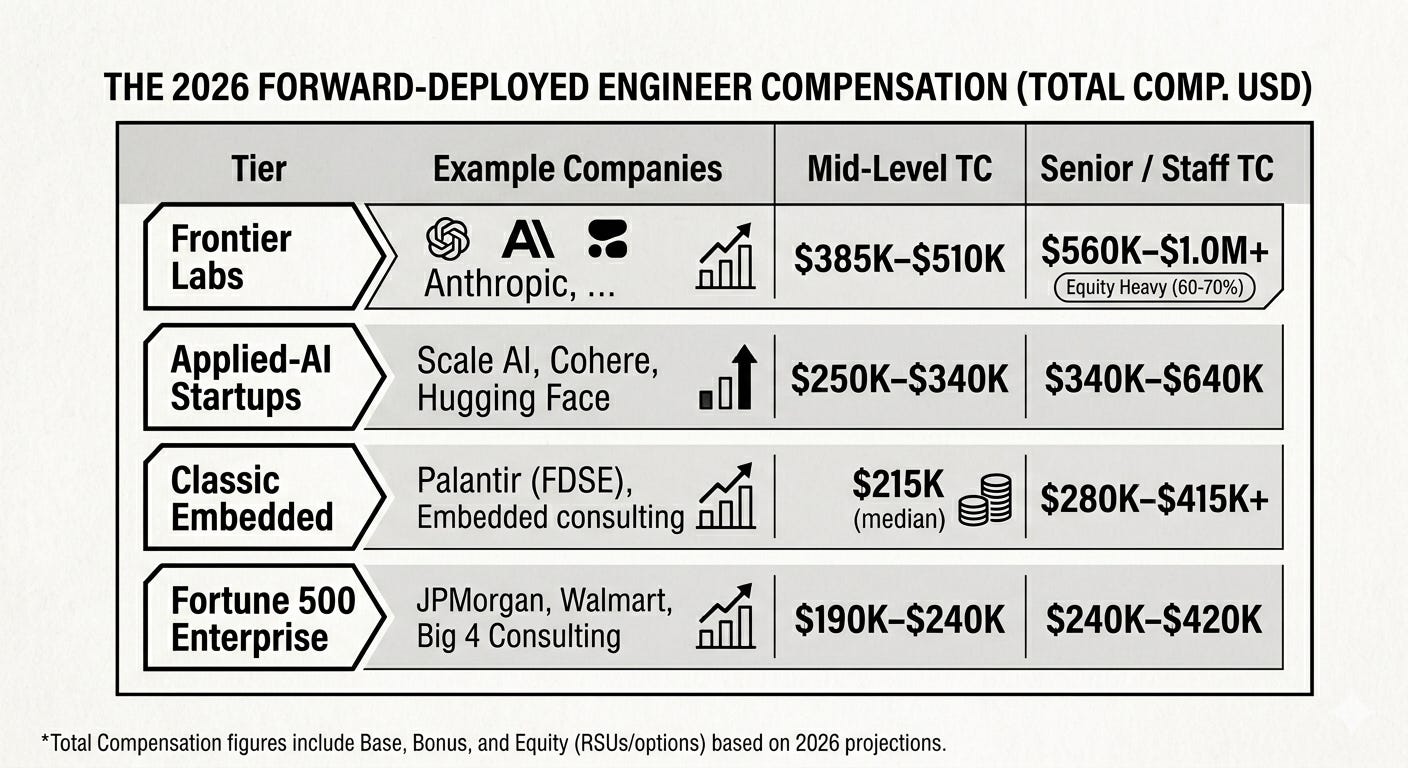
Note: The massive numbers at the Frontier Labs are heavily driven by equity, which now makes up 60–70% of an FDE’s compensation at those companies.
Why so high? Because the FDE is the person standing between an expensive AI investment and zero ROI. When a single deployment can unlock millions in value, or save a multi-million-dollar contract, the engineer who makes it actually work is not a cost center. They’re the deal.
Compensation follows leverage. And right now, the FDE has the most leverage in the building.
To sum it all up, the hottest job in AI right now is the person who can make it work for a customer in production and drive real value. That is the job that is currently worth a fortune.
P.S. Want more? 👋
1/ My visual guide to agentic AI → Gumroad
2/ Deep dives on agentic AI architecture → LinkedIn
3/ Real-time takes on breaking AI news → X
4/ Casual hot takes and community → Threads
5/ Visual frameworks and carousels → Instagram
6/ 60-second production lessons → TikTok
7/ The full newsletter, free → newsletter.karuparti.com
References
Palantir Technologies — origin of the “forward-deployed engineer” term and the ~120 FDEs by 2009: Wikipedia: Palantir Technologies (Palantir Metropolis section, citing Bloomberg).
Shyam Sankar (Palantir CTO) on the forward-deployed model: Palantir Newsroom / Letters.
OpenAI Forward-Deployed Engineer role: OpenAI Careers (FDE roles posted in 2025).
Compensation ranges are directional, drawn from public reporting and crowd-sourced data: levels.fyi (Palantir and OpenAI compensation pages).