

Welcome back to Diary of an AI Architect. Today, we are stepping outside our usual solo deep dives to bring you a guest op-ed by Vishal Singh, Founder & CEO of DataGOL, an AI Native Data and Agents platform built to make enterprise data AI-ready for the next generation of autonomous systems.
Vishal makes the uncomfortable argument most of the industry is still avoiding: your data stack isn't underperforming for AI because it's badly built, but because it was designed for a human reader and not an autonomous one. It's one of the sharpest takes I've read this year, and it comes from someone who has built in exactly the places where complexity, trust, and scale collide. Read this one twice.
Table of Contents
The Data Stack Was Built for a Human Reader
Why AI Exposes the Gaps in Enterprise Data
Governance Without Context Is Not Governance
The Enterprise Memory Gap
From Data-Driven to Context-Driven
1. The Data Stack Was Built for a Human Reader
For the last decade, the work of data teams was designed around a human reader. Pipelines moved data. Warehouses stored it. Transformation layers shaped it. Dashboards displayed it. The architecture assumed that a person would sit in front of a screen, interpret what the numbers meant, and decide what to do next.
That model worked because the human supplied what the stack did not: business context, judgment, memory, and an understanding of exceptions. An analyst knew why a metric moved, which customer was strategic, which policy could bend, and which action would be technically possible but organizationally wrong. Much of that knowledge never lived in a warehouse, BI tool, or transformation layer. It lived in people, meetings, Slack threads, email, documents, and the unwritten operating memory of the business.
AI changes that assumption. The reader is no longer only human. AI agents do not just consume reports; they reason over data, retrieve context, make recommendations, trigger workflows, and increasingly take action. That means the architecture can no longer depend on a human to fill the gaps between systems. The gaps have become the problem.
2. Why AI Exposes the Gaps in Enterprise Data
Most enterprises now operate a collection of specialized tools across ingestion, storage, transformation, metrics, cataloging, governance, observability, and BI. Each tool may be excellent at its function, but together they create seams. Humans have learned to work across those seams. They know which field is trustworthy, which dashboard is canonical, and which definition has changed. Agents do not inherit that tacit map. When meaning is distributed across tools, tickets, conversations, and tribal knowledge, the agent sees data without the operational logic that makes the data safe to use.
3. Governance Without Context Is Not Governance
Furthermore, traditional stacks often treat governance as a layer: permissions in one place, lineage in another, business definitions somewhere else, and policy documents outside the flow of work. That is not enough for AI. Governance is not only a rule; it is the act of deciding how a rule applies in context. A pricing policy may hold until a strategic account, a regulatory constraint, or an executive decision makes the standard rule inappropriate. Those exceptions are not edge cases. They are where much of the organization’s real judgment and authority reside. If that judgment is not captured where the work happens, an agent can follow the rule and still make the wrong decision.
4. The Enterprise Memory Gap
The modern data stack is good at storing artifacts: tables, dashboards, logs, and metrics. It is much weaker at preserving the reasoning that produced them. Why was the definition changed? Who approved an exception? What happened after a prior decision? Which tradeoff was accepted and why?
Today, that memory is scattered across unstructured sources and human recollection. For agents, retrieving fragments from those sources is possible, but it is brittle. Without a structured memory layer, an AI system may be technically connected to information yet still lack the continuity required to reason responsibly.
5. From Data-Driven to Context-Driven
Dashboards were built for interpretation, not autonomous action. A human can look at a chart and ask follow-up questions. An agent needs live business context on the same surface where it reasons and acts: definitions, permissions, lineage, exceptions, policies, semantic meaning, and memory. A context layer bolted onto the side of an existing stack may help with search, but it does not solve the architectural issue. Context has to be produced, governed, and updated as part of the operating system of the business.
This is why the traditional data stack did not fail because it was badly designed. It failed for AI because it was designed for a different reader. It is optimized for human interpretation. AI requires an architecture for governed reasoning and action.
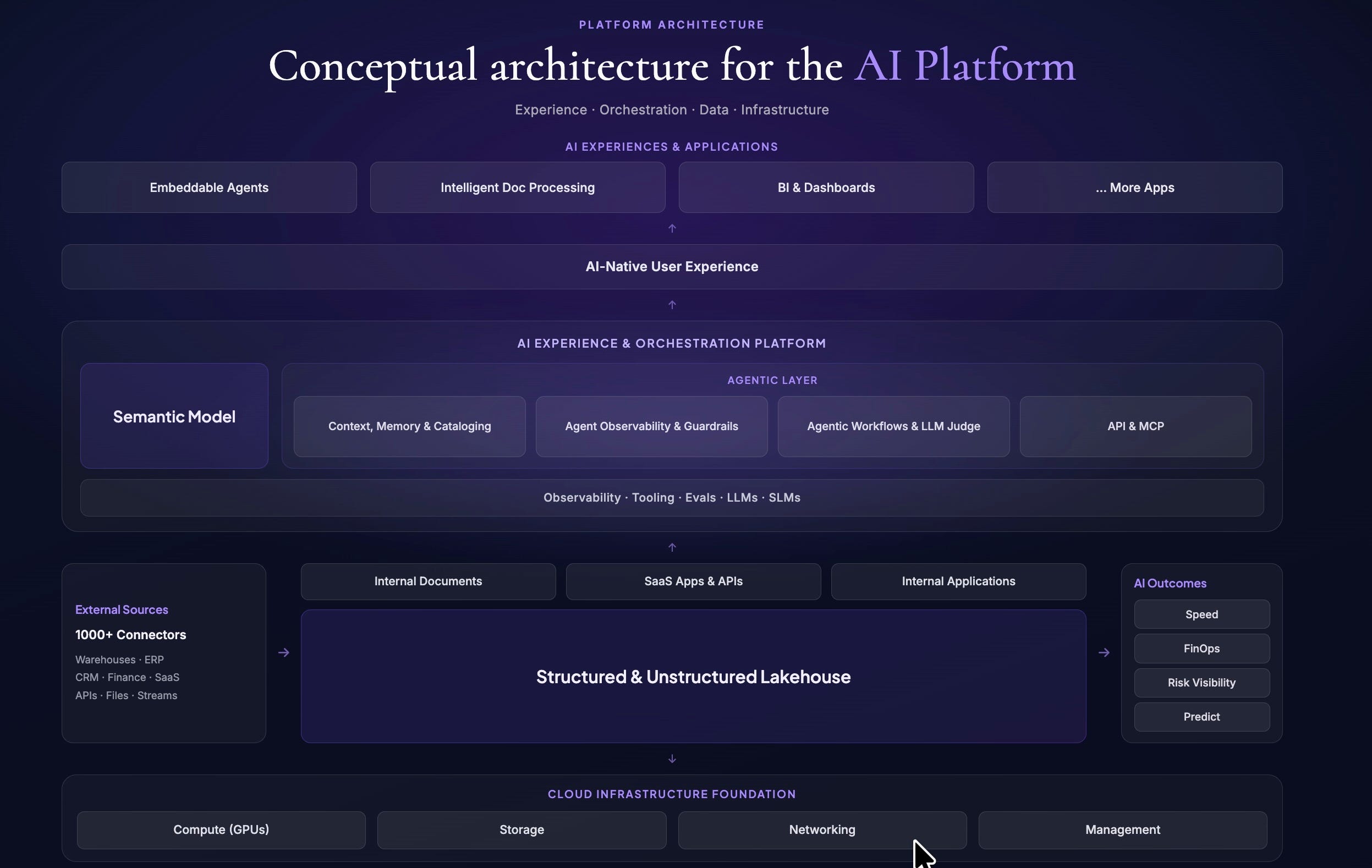
The next generation of data architecture will need to bring the data plane, control plane, and context plane closer together. Ingestion, semantic modeling, governance, memory, and agent orchestration cannot remain isolated functions connected only through pipelines and human coordination.
They need to operate on a shared substrate where context is created as work happens, where rules and exceptions live together, and where agents can reason with the same constraints that the organization expects people to follow.
This does not mean every enterprise should discard its existing investments. The practical path is more likely to be evolutionary: identify the workflows where agents are expected to act, map the context and governance those workflows require, and build an AI-ready layer that can unify structured data, unstructured knowledge, policies, memory, and orchestration.
The goal is not another dashboard. The goal is an environment where humans and agents can operate from the same governed understanding of the business.
An AI-native data systems need to treat context as a first-class architectural concern, not as an afterthought. The broader shift is bigger than any one vendor. As AI agents become participants in business operations, organizations will need architectures that capture not only data, but also meaning, memory, and judgment. The companies that solve that problem will move beyond being data-driven. They will become context-driven.
About Vishal Singh: Vishal Singh is the Founder and CEO of DataGOL, an Agentic Data and AI Agents platform built to make enterprise data AI-ready for the next generation of autonomous systems. A repeat founder and enterprise software operator, Vishal previously co-founded Link3D, where he helped build additive workflow and digital manufacturing software for complex industrial environments before the company was acquired by Materialise NV, listed on Nasdaq under MTLS. He also co-founded Termgrid, a SaaS platform modernizing private capital markets workflows where he leveraged network effects and data moat
Across SaaS, network effects, data platforms, AI, and regulated industries, Vishal has repeatedly built software where complexity, trust, and scale collide. DataGOL emerged from his conviction that AI agents cannot transform the enterprise unless they are grounded in governed, reusable, AI-ready data. His mission is to collapse fragmented data stacks into intelligent infrastructure that lets enterprises move faster, spend less, and deploy AI with confidence.