

Saturday evening, 6 PM. Dinner guests were arriving in an hour, and I had a plan. I’d handle the grill. My wife was setting the table. My sister-in-law volunteered to make salad. My friend, a self-appointed DJ took charge of the music.
Thirty minutes later, it was chaos. The grill wasn’t heating because I’d forgotten the propane valve. My sister-in-law was waiting for me to bring the ingredients I thought she already had.
My wife was frantically reheating appetizers I thought were already done. And the “DJ” had paired his phone to the wrong speaker, blasting EDM in the baby’s room.
No one was useless. Everyone was capable. But nobody knew what the others were doing.
That’s the core failure of most multi-agent AI systems today. Each agent is skilled a coder, a researcher, a planner, a writer, but without shared memory, context, and coordination, the whole thing turns into a dinner party gone wrong.
The magic isn’t in smarter agents. It’s in smarter orchestration. And that’s where new frameworks like Microsoft’s multi-agent architecture start to actually feel like a team, not a group chat with no moderator.
This Microsoft’s recent architecture diagram captures something important that most multi-agent systems are missing today.
Let me walk you through why this matters, and what we can learn about building systems that actually work in production.

Why Most Multi-Agent Systems Fail
Before we dive into the solution, let’s understand the problem. When you move from a single AI agent to multiple agents working together, you don’t just add complexity.
You multiply it. Here’s what typically breaks:
The Chaos Problem: Without clear orchestration, agents talk over each other, duplicate work, or worse. Contradict each other’s actions. You may encounter systems where one agent would fetch data while another was simultaneously deleting it.
The Amnesia Problem: Agents forget what they were doing, lose context, or can’t access information from previous interactions. It’s like having a team where everyone has short-term memory loss.
The Black Box Problem: When something goes wrong (and it will), you have no idea which agent caused the issue, what state the system was in, or how to reproduce the failure.
The Five Layers Every Multi-Agent System Needs
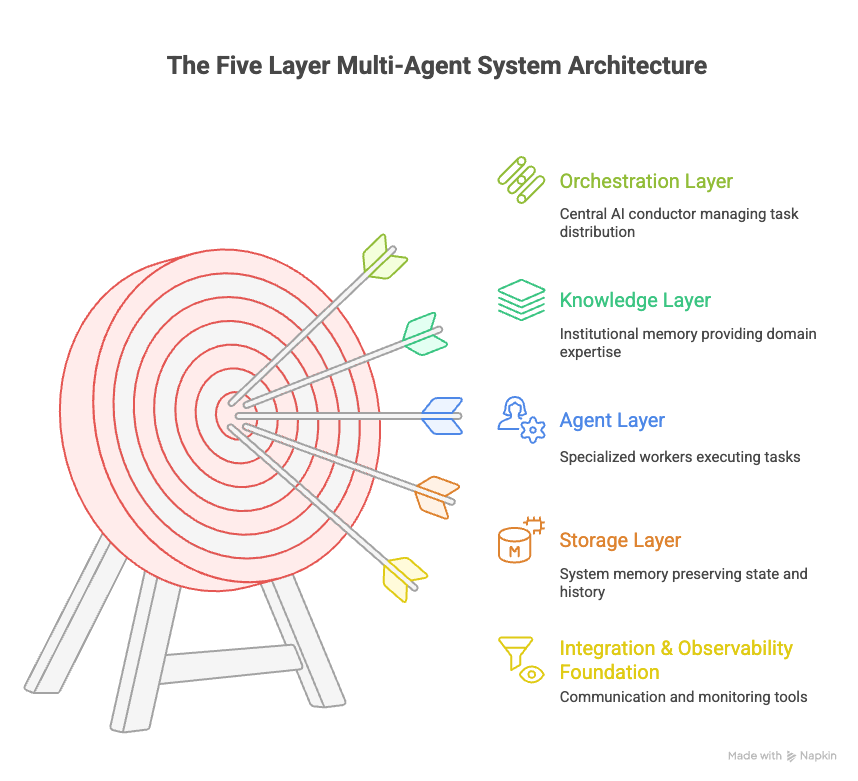
Microsoft’s architecture breaks down multi-agent orchestration into five essential layers. Think of these as the skeletal structure. Without them, your system collapses.
1. The Orchestration Layer: Your AI Conductor
At the top sits the Orchestrator, powered by a framework like Microsoft’s Agent Framework (MAF) that was launched in early October 2025. It is a powerful amalgamation of Semantic Kernel and Autogen. This is your conductor. The component that decides which agents do what, when, and with what information.
Why you need it: Without a central orchestrator, you’re essentially running a group chat where everyone shouts simultaneously. The orchestrator maintains the flow of execution, routes tasks to the right agents, and ensures work doesn’t duplicate or conflict.
The clever part here is the Classifier component. It uses NLU, SLM, or LLM models to understand intent and route requests appropriately. This means your system can intelligently decide “this needs the research agent” versus “this needs both the research and writing agents, in sequence.”
The Agent Registry acts as your system’s phonebook. It knows what agents exist, what they’re capable of, and whether they’re currently available. This becomes critical when you scale beyond 2-3 agents.
2. The Knowledge Layer: Institutional Memory
Your agents need two things: domain knowledge and semantic search.
Source Bases are where you store specialized knowledge that transforms generic AI responses into expert answers.
You can deliver this through RAG (retrieval at inference time), fine-tuning smaller models on your data, or hybrid approaches. The implementation varies - knowledge graphs, FAQ databases, document repositories. But the goal is the same: give agents the specific information they need.
High-quality domain knowledge is your competitive advantage. It turns general-purpose AI into specialized experts that understand your business.
Vector DBs enable semantic search across unstructured data.
Tools like Azure AI Search and Cosmos DB let agents find information based on meaning, not just keyword matching.
When your support agent searches “issues with login after password reset,” vector search understands the conceptual relationship between authentication and credentials. It doesn’t just match exact text.
Think of this as your agents’ research library. Without it, they’re limited to pre-trained knowledge.
With it, they access your organization’s full institutional knowledge, searchable in ways that actually make sense.
3. The Agent Layer: Your Specialized Workers
Specialized Agents (Agent #1, #2, #3, #4) are your expert workers. Each focuses on a specific domain - finance, coding, research, creative writing using fine-tuned models, RAG with domain knowledge.
They communicate via MCP Client, which standardizes how agents talk to external tools, handles authentication, manages connections, and formats requests.
Local vs. Remote: The Critical Difference
Local agents run in the same environment as your orchestrator. They’re fast, trusted, and communicate in-memory.
Remote agents operate across network boundaries. This is where security gets serious.
When remote agents communicate using protocols like Agent-to-Agent (A2A), you need additional security layers because:
Trust boundaries: Remote agents might be in different security zones, owned by different teams, or even external services
Network exposure: Communication travels over networks that could be intercepted or compromised
Authentication required: You need to verify the remote agent is who it claims to be
Authorization checks: Just because an agent can connect doesn’t mean it should access everything
Data in transit: Sensitive information moving between agents needs encryption
Think of it like this: local agents are coworkers in your office. Remote agents are contractors calling in - who need badges, credentials, and verification before letting them access your systems.
4. The Storage Layer: System Memory
Here’s where most homegrown multi-agent systems fail catastrophically: they don’t properly persist state.
Your system needs three types of memory: Conversation History (every interaction and decision for continuity and debugging), Agent State (operational status and configuration so agents can recover from failures), and Registry Storage (metadata about what agents exist and what they can do).
Without proper storage, your agents forget everything between sessions, can’t learn from past experiences, and start from scratch every time.
5. The Integration & Observability Foundation
The bottom two layers are often afterthoughts, but they’re what separates proof-of-concepts from production systems.
Integration Layer & MCP Server
This handles communication with external tools - databases, APIs, calculators, web search, whatever external capabilities your agents need.
The MCP Server standardizes how agents interact with these tools, preventing the nightmare of maintaining custom integrations for each agent.
External Tools
Your agents aren’t self-contained.
They need to search the web, query databases, make API calls, and run code. This layer manages those integrations cleanly so agents can focus on their core tasks.
Observability and Trace
This is your cockpit. Your real-time view into what’s actually happening.
Which agents are active? What tasks are executing? Where are the bottlenecks? Where do failures occur? How long does each action take?
Observability means tracing every action your agents take and monitoring operational metrics like cost and token usage across your entire system.
Without visibility, you’re flying blind.
Evaluation
The feedback loop that makes your system better over time.
How well are your agents performing? Where are they making mistakes? What’s working and what isn’t?
This data feeds back into your orchestrator, enabling continuous improvement.
Here’s the truth: unless you measure your AI system, you can’t track progress against your baseline. You can’t improve what you don’t measure.
I have tried my best to simplify this architecture. But for a deeper technical understanding I highly recommend reading this blog from Microsoft.
Why This Architecture Matters
What makes Microsoft’s approach compelling isn’t novel AI research. It’s engineering pragmatism. This architecture solves real problems:
Scalability: You can add new agents without rewriting your orchestration logic. The registry pattern means the system discovers and routes to new capabilities automatically.
Debuggability: With proper observability and state management, when things break (and they will), you can actually figure out why.
Reliability: Persistent state means agents can recover from failures. The supervisor pattern means local failures don’t cascade into system failures.
Flexibility: The separation between local and remote agents means you can scale different parts of your system independently based on load and requirements.
The Real Lesson
Building multi-agent systems isn’t about having the most sophisticated AI models. It’s about having the right architecture. Just like my family’s dinner planning fiasco wasn’t because we didn’t know how to do our jobs - it failed because there was no system for coordination.
Your orchestration layer is your system for coordination.
Your storage layer is your institutional memory.
Your observability layer is how you learn and improve.
Miss any of these, and you’re building a demo, not a production-grade system.
The architecture Microsoft presents isn’t the only way to build multi-agent systems, but it captures the essential components that every production system needs.
Whether you’re using LangGraph, CrewAI, or building something custom, you need to solve these same fundamental problems.
Architecture is critical. The intelligence of your individual agents matters far less than the coherence of your system.
What multi-agent architectures have you found successful? What patterns have failed spectacularly? I’d love to hear about your experiences in the comments.