

Most AI systems process a request and stop. The ones that win never stop. They close the loop.
There is a term spreading through the agent-building community right now: loop engineering. The internet is buzzing about it, and like most things that go viral fast. So, I spent the last two weeks pulling it apart to figure out what is real, what is hype, and what actually matters for teams shipping agents into production.
Here is what I found. Loop engineering is not a new model. It is not a framework you install. It is a way of thinking about the architecture of long-running, self-improving systems.
The term was popularized by popularized by top engineering leaders like Boris Cherny (Head of Claude Code), Addy Osmani (Google’s Engineering Leader) and Peter Steinbeger (Creator of OpenClaw)
This week’s edition is about that difference, and the six engineering layers that make it possible.
The enterprise pain points
Imagine you are the platform lead at a mid-sized insurance company. Your team has built a claims-triage agent that reads incoming claims, classifies them, pulls the relevant policy, and drafts a recommendation for a human adjuster.
It works. On launch day it handles 60% of routine claims without escalation, and leadership is thrilled.
Then it stops getting better. Six weeks later it is still at 60%. The same edge cases fail the same way. The agent misreads the same ambiguous policy clauses on Monday that it misread the previous Monday. Adjusters start double-checking everything, which erases most of the time savings.
The diagnosis is simple. They built an open-loop system. A request comes in, the agent processes it, an answer comes out, and that is the end of the line. Nothing flows back. The agent has no way to notice it was wrong, no way to learn from the adjuster’s correction, no memory of last week’s mistake. It is a very expensive function call.
Your team built an agent. But what is needed is a loop.
The framework: open loop versus closed loop
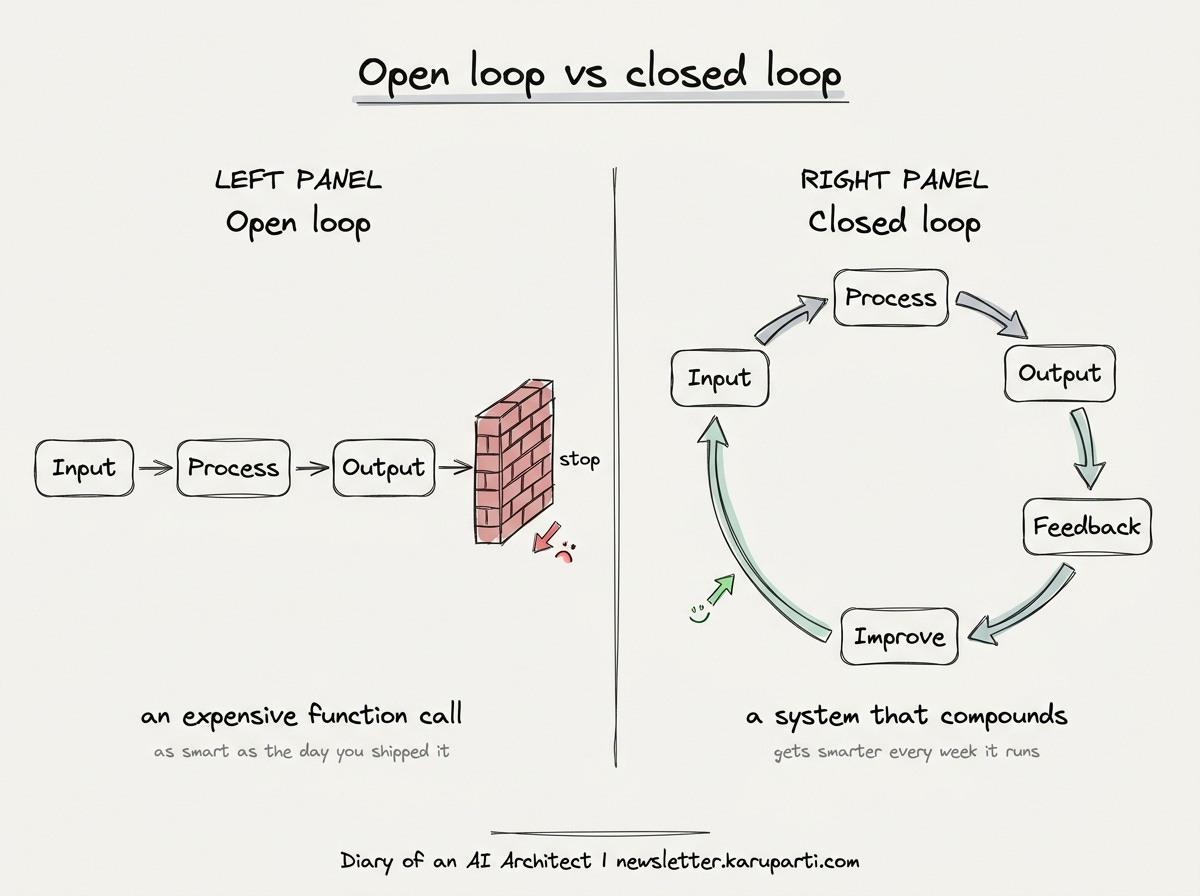
Most AI systems today look like this:
Input → Process → Output → (stop)
A self-improving system looks like this:
Input → Process → Output → Feedback → Improve → back to Input
That second arrow, the one that bends back to the beginning, is the entire game. It is the difference between a system that is as smart as the day you shipped it and a system that compounds.
But that loop is not magic, and this is where most of the loop engineering hype falls apart. People talk about self-improving agents like you sprinkle a feedback step on top and intelligence emerges. It does not work that way.
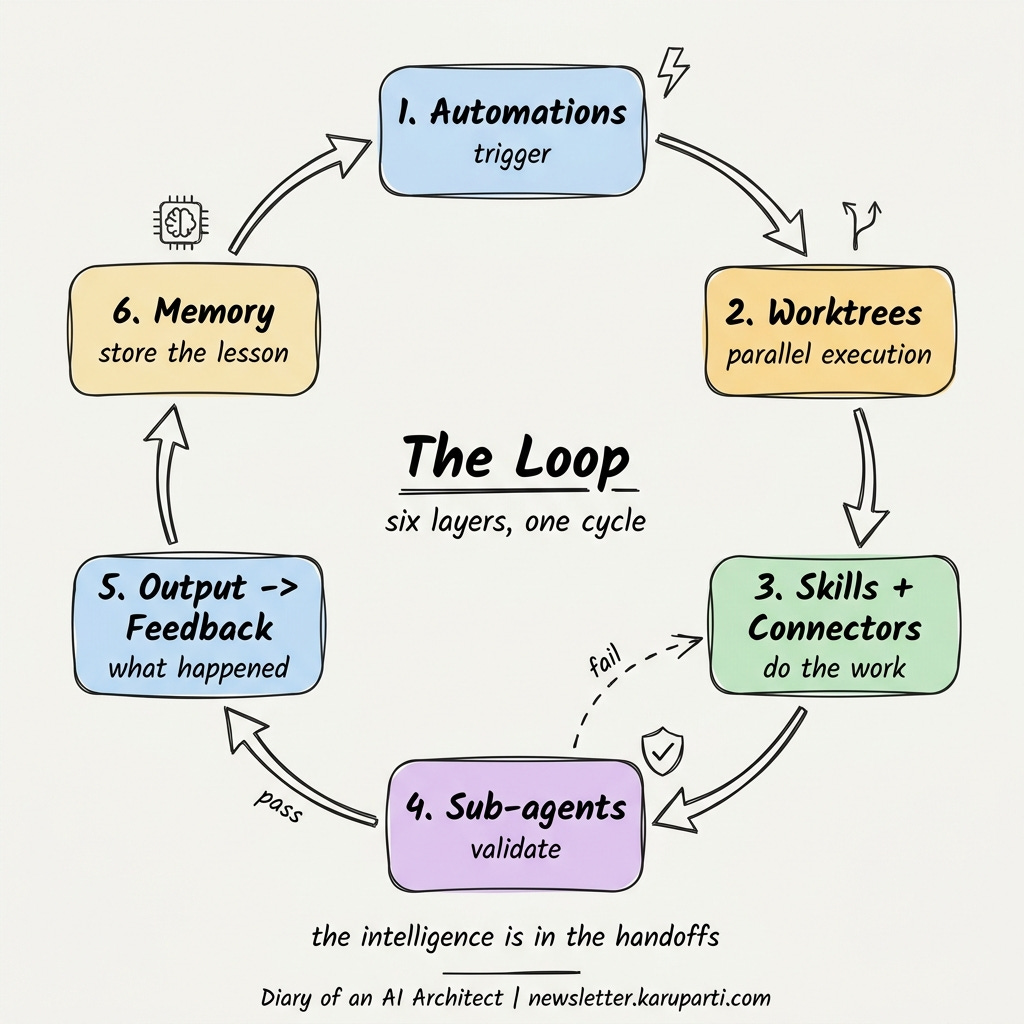
The loop is held together by six engineering layers. Each one is a real architectural decision with real trade-offs. Get all six working together and the loop closes.
The six layers are:
Automations: the trigger layer
Worktrees: the parallel execution layer
Skills: the procedural memory layer
Connectors: the real-world links layer
Sub-agents: the validation layer
Memory: the state layer
Let’s go through each one.
Layer 1: Automations, the trigger layer
The first thing a self-improving system needs is a way to start without you.
Automations initiate workflows based on time, events, or system conditions. An email arrives. A database row updates. A calendar event fires. A claim lands in the queue. The trigger launches the full pipeline so execution is structured, not ad hoc.
This is the layer that moves an agent from “I asked it” to “it noticed and started on its own.” That shift sounds small. It is not. An agent you have to invoke is a tool. An agent that responds to the world is a system.
The architectural caution: triggers are where runaway loops are born. An event-driven agent that triggers another event can cascade. Before you wire automations, define the kill switch and the rate limit. A loop that starts itself must also be a loop you can stop.
