

Two open-source projects just redrew the map for what multi-agent systems will look like running organizations in the next two years.
They both message you on WhatsApp,Telegram and other channels. They both read your files, run your shell, and complete real tasks while you sleep. And they have almost nothing in common under the hood.
That gap is not a feature gap. It is an architecture decision, and it is the same decision every enterprise team will face in 2027 when they stop buying chatbots and start running agents.
I put together a short video comparing the two this week. But before you watch it, I want to give you the mental model that makes the comparison actually land.
OpenClaw and Hermes represent two genuinely different bets on how intelligent work gets organized: one optimizes for breadth across many domains, the other for depth within a single reasoning loop.
The architecture below represents my perspective on how the multi-agent enterprise will evolve with these two frameworks. It brings together the two architectural philosophies discussed in this article. Before exploring the architecture itself, let's examine each philosophy.
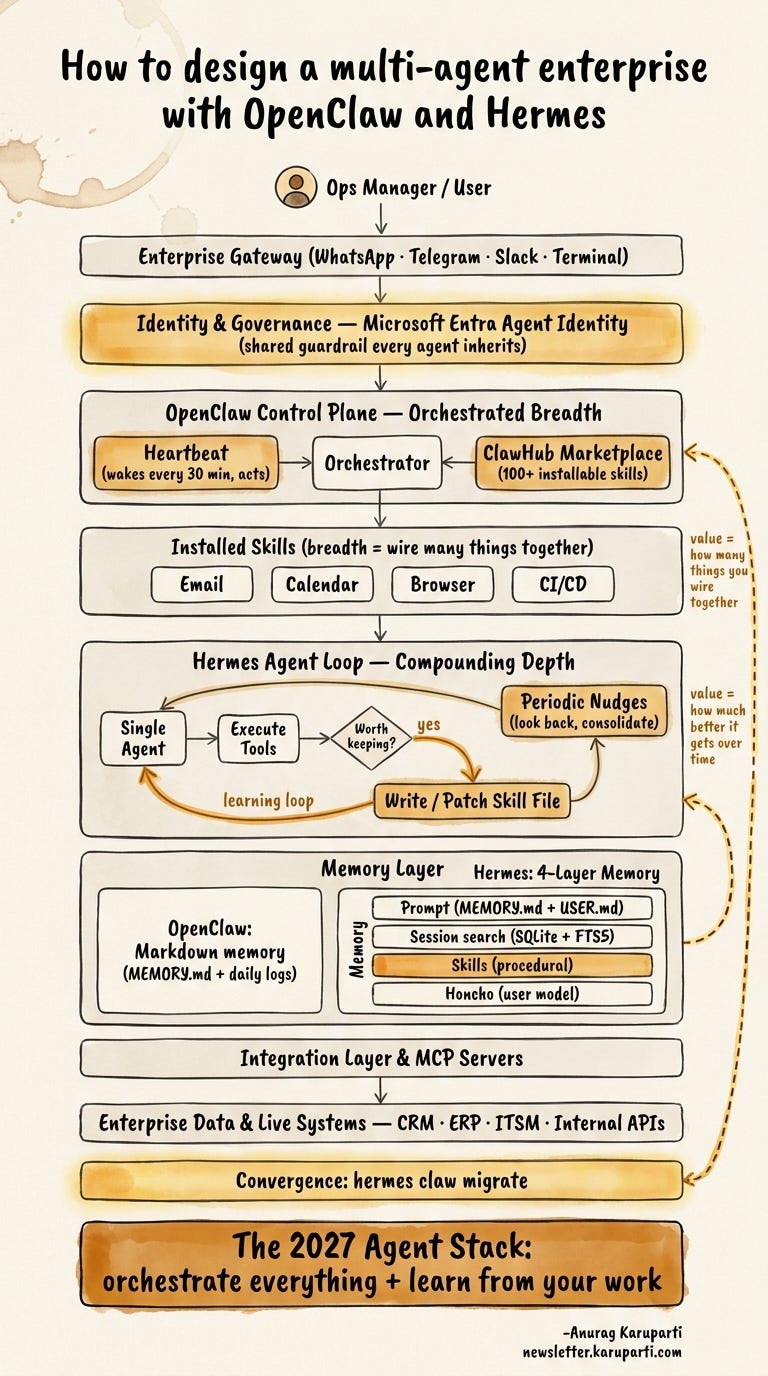
The framework: orchestrated breadth vs compounding depth
OpenClaw for Orchestrated Breadth
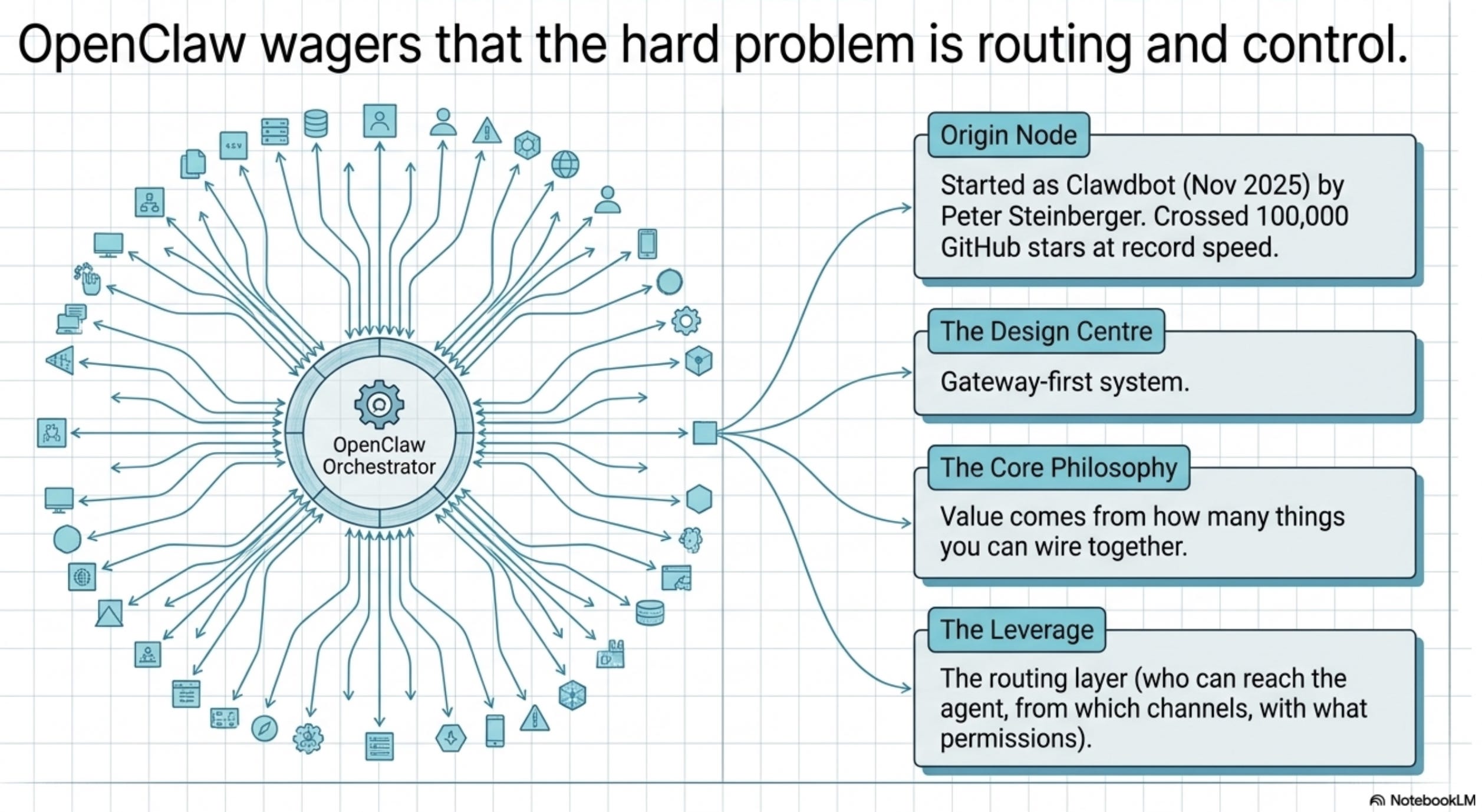
OpenClaw is a gateway-first system. Its core bet is that the hard problem is routing and control - who can reach your agent, from which channels, under what permissions, with what downstream handoffs.
It is hub-centric by design: a central orchestrator managing multiple agents across diverse messaging platforms, with a large pre-built skill ecosystem and explicit multi-agent coordination.
The framework is opinionated about surfaces and flexible about everything else. If your problem is communication complexity across a team or organization, OpenClaw is built for that surface area.
Hermes for Compounding depth
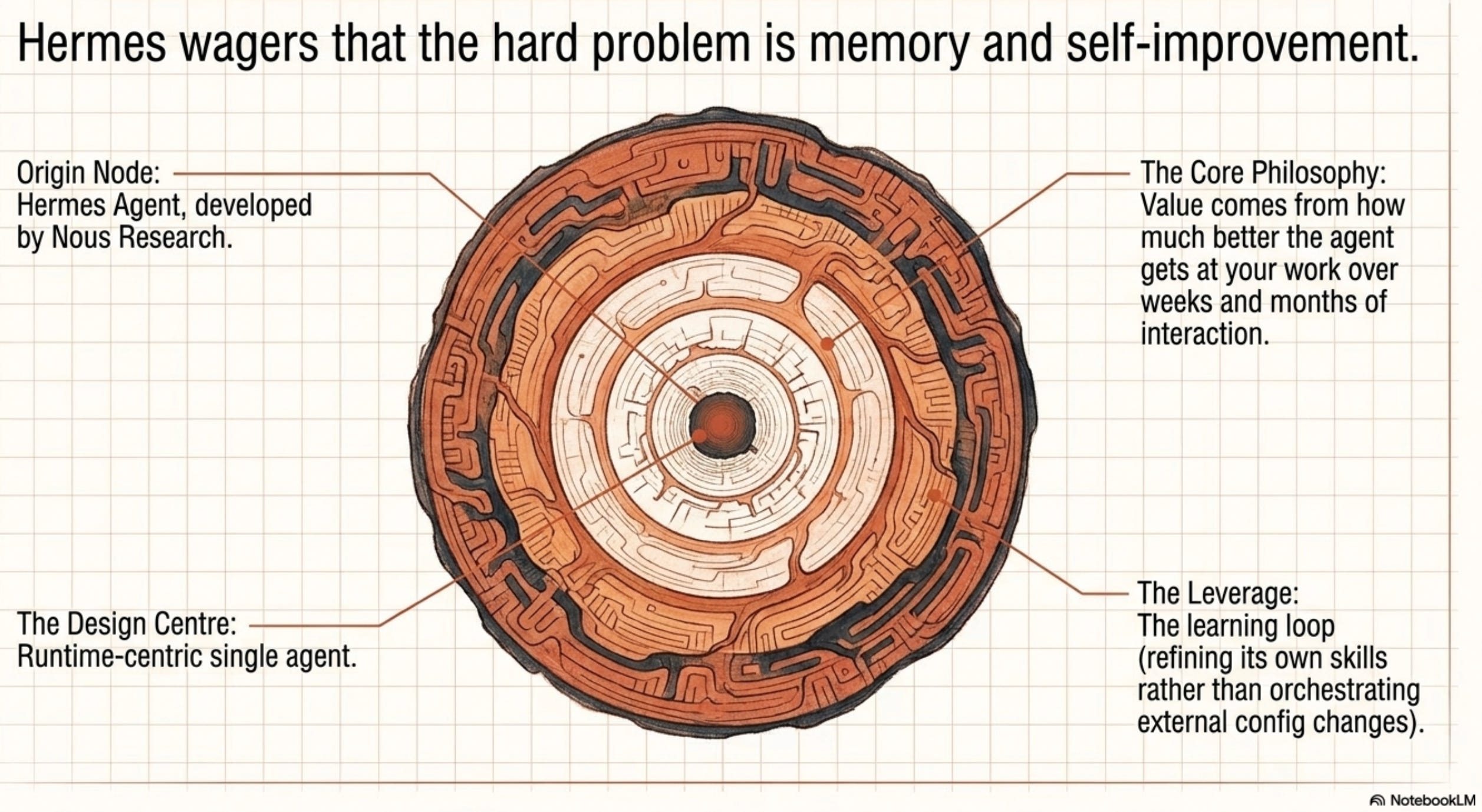
Hermes takes the opposite bet. The hard problem, in its view, is memory and self-improvement.
Hermes is a runtime-centric agent that writes and refines its own skills, retains context across sessions, and optimizes for repeated workflows over time. It is not trying to be everywhere.
It is trying to become indispensable, increasingly useful for the specific work you do, across weeks and months of interaction.
Neither is more advanced. They are different wagers on where the value actually lives.
OpenClaw: the leverage is in the routing layer.
Hermes: the leverage is in the learning loop.
OpenClaw: the orchestration philosophy
OpenClaw started life in November 2025 as Clawdbot, built by Peter Steinberger. After a trademark scuffle with Anthropic over the “Clawd” name and a fast double rename, it landed as OpenClaw and became one of the fastest projects in GitHub history to cross 100,000 stars. The design center is clear once you look at the pieces.
A heartbeat, not a prompt
A normal chatbot waits for you to type. OpenClaw runs a heartbeat: every 30 minutes it wakes up, checks for pending tasks, and acts without being asked. That one decision turns a question-answering tool into a proactive operator.
It is the difference between “AI that answers” and “AI that monitors, then acts, then messages you.”
Markdown memory you can read
Memory is not a vector database you have to trust. It is plain Markdown files on your disk: a curated MEMORY.md for long-term knowledge plus dated daily logs the agent reads at the start of each session.
Skills as a marketplace
Capabilities come from modular plugins pulled from the ClawHub marketplace. Over 5,700 community skills cover everything from email triage and calendar sync to browser automation and CI/CD monitoring.
The mental model is an app store for your agent: want a new behavior, install a skill.
Breadth as the product
OpenClaw speaks 50-plus messaging platforms, is model-agnostic across Claude, GPT, and local models, and treats its gateway as a thin delivery layer.
The philosophy in one line: value comes from how many things you can wire together.
Access is key here.
The risk in one line: the same breadth and system access got it called a “security nightmare” by Cisco, with malicious skills and exposed instances showing up in the wild.
Orchestrated breadth is powerful and it is also a wide attack surface.
Hermes: the learning philosophy
Hermes Agent, from Nous Research, makes the opposite bet. Where OpenClaw orchestrates many agents and many skills, Hermes is a single agent that gets more capable the longer it runs, not through config changes but through actual use.
The architecture is built around one idea: close the loop between what happened and what worked.
The learning loop
This is the heart of it. As a session runs, Hermes gets periodic nudges, internal prompts that ask the agent to look back and decide what is worth keeping.
When it finishes a task that took real work (five or more tool calls, a recovery from an error, a user correction, a non-obvious workflow), it writes a new skill file to disk. Not a log of what happened, a reusable procedure for next time.
And it keeps editing those skills, preferring small patches over rewrites so it never breaks what already works.
Four layers of memory, separated on purpose
Most agent memory rots because everything gets dumped into one store. Hermes splits it into four:
Prompt memory (
MEMORY.md+USER.md): always-on, injected into every system prompt, deliberately capped near 3,500 characters to force curation over hoarding.Session search (SQLite + FTS5): every session is archived and full-text indexed, retrieved on demand and summarized before it re-enters context.
Skills (procedural memory): how-to knowledge, loaded on demand so a large skill library costs far less context than loading everything up front.
Honcho (passive user modeling): It is an AI-native memory backend that adds dialectic reasoning to Hermes. Instead of key-value storage, it keeps a running model of your preferences, style, goals, and patterns by reasoning about conversations after they happen.
The distinction that matters: episodic memory (”what happened”) is kept separate from procedural memory (”how to do it”). That separation is why the system stays reliable as it grows.
The loop is the gateway
In OpenClaw the gateway just delivers messages. In Hermes the gateway is part of the same loop: an incoming message can trigger skill creation, a scheduled job writes its result back through the same path, and a conversation started on Telegram continues in your terminal because the session is tied to an ID, not a platform. Token caching, automatic provider fallback, and compression-as-consolidation round it out. The philosophy in one line: value comes from how much better the agent gets at your work over time.
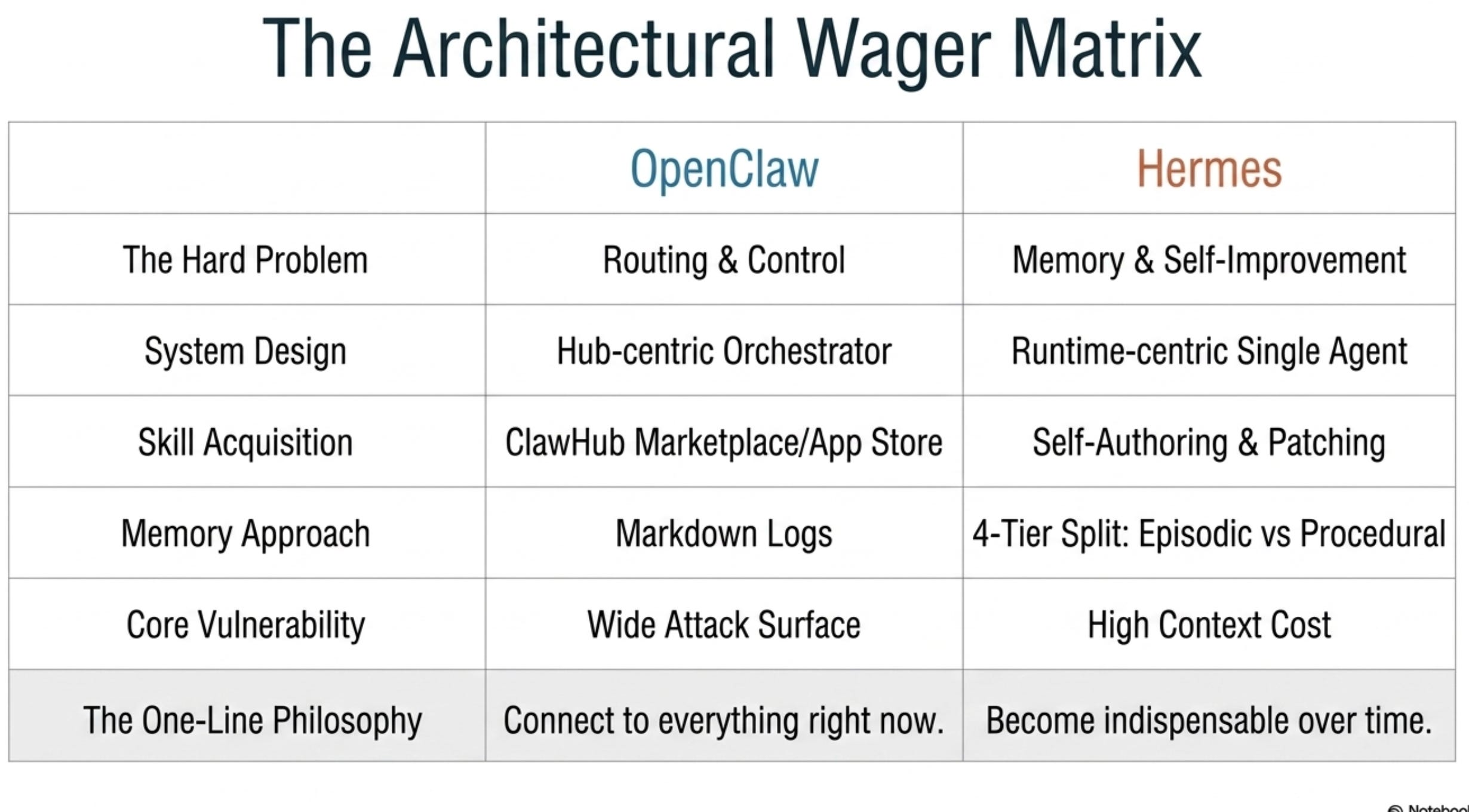
When to use one over the other: enterprise use cases
The fastest way to make this concrete is to stop thinking about features and start thinking about the job.
Hermes fits enterprise workloads that demand deep, adaptive intelligence over a focused set of specialized internal data.
OpenClaw fits workloads that demand broad, multi-channel connectivity across many systems, with governance enforced as a guardrail you wrap around it rather than a property you get for free.
Here is where each philosophy actually wins inside a large organization.
Enterprise use cases for Hermes (narrow and deep):
Legacy code modernization. Hermes analyzes an outdated, poorly documented repository, maps dependencies, and learns to generate compliant migrations to modern frameworks, accumulating context on the internal code quirks with every pass so the tenth module is migrated better than the first.
Complex R&D knowledge synthesis. Clinical researchers or patent attorneys point Hermes at a growing library of highly technical documents. The moat is not bulk indexing, it is the custom analytical skills the agent writes to surface non-obvious cross-references, skills that get sharper with every paper it works through.
Hyper-personalized customer escalations. For tier-3 support, Hermes learns individual enterprise-client SLA preferences, past resolution history, and technical environments, then drafts uniquely tailored fixes for the specific, recurring glitches each account hits.
Enterprise use cases for OpenClaw (wide and shallow):
Omnichannel incident response. When a system outage hits, OpenClaw orchestrates the whole response at once: pull logs from AWS, open a Jira ticket, alert engineers in Slack, and broadcast status to clients over WhatsApp and email, concurrently.
Cross-department employee onboarding. OpenClaw handles the diverse one-off tasks of hiring: provision a Google Workspace account, trigger a Slack invite, request equipment through an internal procurement API, and track completion inside Workday.
The honest enterprise answer is rarely all-or-nothing. Use breadth for the long tail of integrations and cross-system workflows, and depth for the handful of specialized, recurring workloads where the agent compounds context.
Match the architecture to the shape of the work, not the other way around.
The convergence of two frameworks
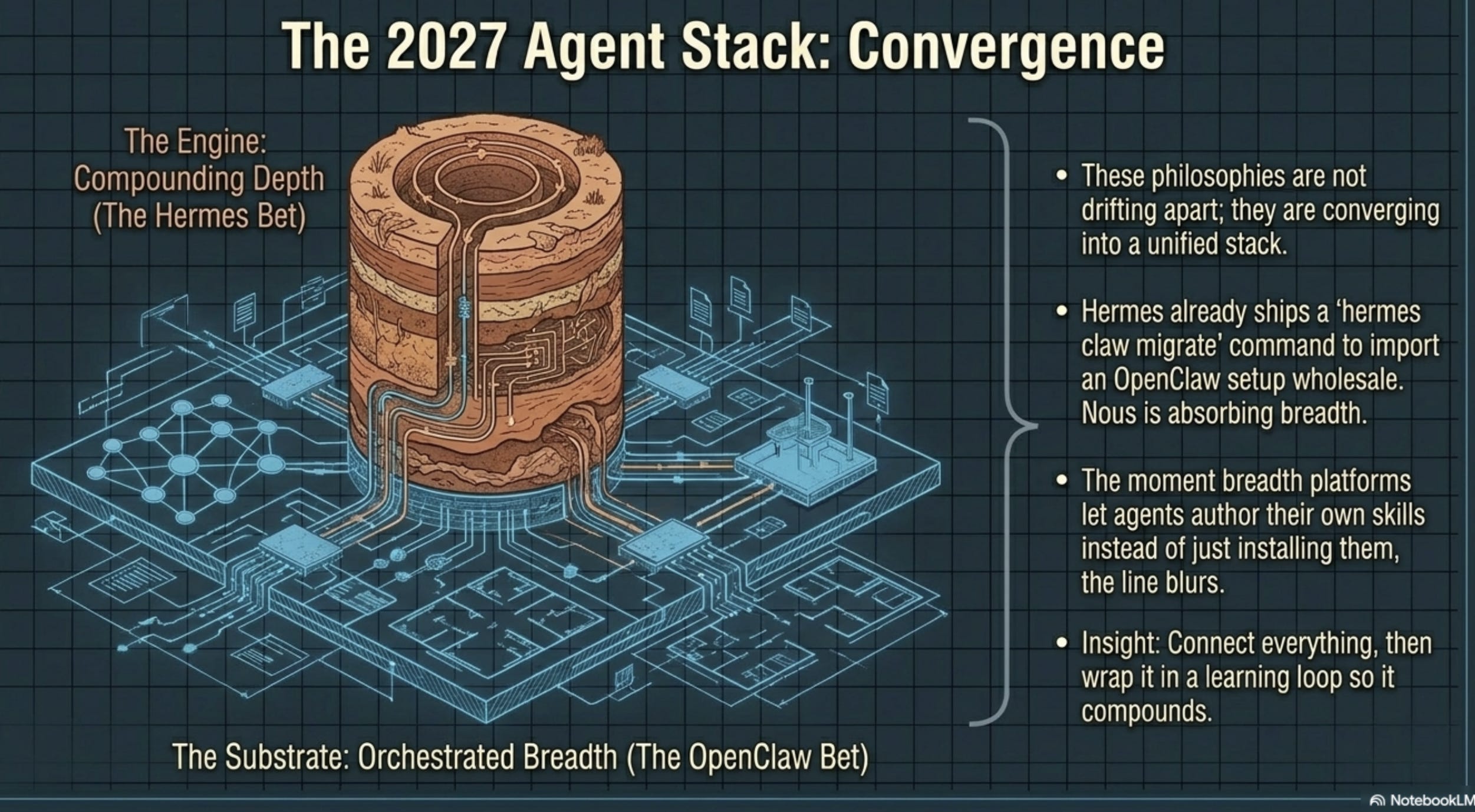
Here is the part most people miss when they treat this as a versus. These two philosophies are not drifting apart, they are converging.
The clearest signal is that Hermes ships a hermes claw migrate command to import an OpenClaw setup wholesale. Nous is not ignoring breadth, it is absorbing it: take everything you wired together in the orchestration world, then wrap it in a learning loop so it compounds. Depth is positioning itself as the next layer on top of breadth, not a replacement for it.
The reverse pressure is just as real. OpenClaw’s marketplace is full of skills, but the obvious next step for any orchestration platform is letting the agent author and refine its own skills instead of only installing them. The moment breadth platforms add a learning loop, the line between the two blurs.
You can already see where this lands. The agent stack for 2027 is not “breadth OR depth,” it is a single system that orchestrates many skills and channels (the OpenClaw bet) while continuously learning from its own work (the Hermes bet).
Connect-everything becomes the substrate; get-better-over-time becomes the engine that runs on top of it.
So if you are choosing today, choose for where you are now: breadth if you are exploring and need reach, depth if your workflows have stabilized and you want compounding returns.
But architect for convergence. Keep your memory, skills, orchestration, and identity as separate, swappable concerns, and the philosophy you pick today becomes an implementation detail you can upgrade tomorrow, not a wall you build around yourself.
The bottom line
OpenClaw and Hermes are not competing on features, they are competing on philosophy: orchestrated breadth that does more today, versus compounding depth that gets better over time.
The teams that win in 2027 will not be the ones with the most skills installed, they will be the ones who matched the architecture to the shape of the work.
References
OpenClaw documentation, “Introduction to OpenClaw” (heartbeat, Markdown memory, history, security): clawdocs.org
OpenClaw ecosystem hub (AgentSkills, ClawHub, origin as Clawdbot, GitHub traction): openclaw-ai.dev
Mr. Ånand, “Inside Hermes Agent: How a Self-Improving AI Agent Actually Works” (learning loop, four-layer memory, gateway, agent loop): mranand.substack.com
Hermes Agent community site (capabilities, platforms, sandbox backends, OpenClaw migration): hermesagents.net
Nous Research, Hermes Agent: hermes-agent.nousresearch.com
agentskills.io open skill specification: agentskills.io