

If you follow me on LinkedIn, you have probably seen the diagram below I shared last week. The one that made a lot of people stop scrolling. When you see the full Microsoft Azure AI Ecosystem laid out in one visual, something clicks. This is not a product. It is a platform strategy decades in the making.
Microsoft has cultivated a formidable enterprise AI moat by moving beyond individual tools to offer a unified platform strategy two decades in the development. This ecosystem addresses the common corporate struggle of fragmented AI pilots by integrating diverse language models, rigorous security protocols, and native data services into one governed stack.
Central to this approach is the ability to maintain strict compliance and identity management through a shared infrastructure that spans from custom silicon to familiar workplace software like Teams.
By weaving autonomous agent governance and future-proof security into the architecture, the company eliminates the need for complex custom integrations.
Microsoft’s competitive edge lies in this deeply integrated surface area, which provides businesses with a secure, scalable path to production that competitors cannot easily replicate.
The story
Picture the CTO of a Fortune 500 insurance company. $2B in annual premiums. 4,000 employees. Eighteen months ago, she greenlit an ambitious AI roadmap: intelligent claims processing, fraud detection, customer-facing virtual agents. Her teams were energized.
Twelve months later? Six disconnected AI pilots. Four different vendors. Two security incidents that nearly made the board pull the plug. And a $14M spend with almost nothing in production.
The problem was not ambition. It was not talent. It was fragmentation. Every tool had a different identity model. Every model had a different compliance posture. No one could answer the CISO’s question: “Where is our data, who touched it, and can we prove it?”
This is the enterprise AI reality that nobody on stage at tech conferences talks about. And it is exactly the problem Microsoft has spent years architecting a solution for.
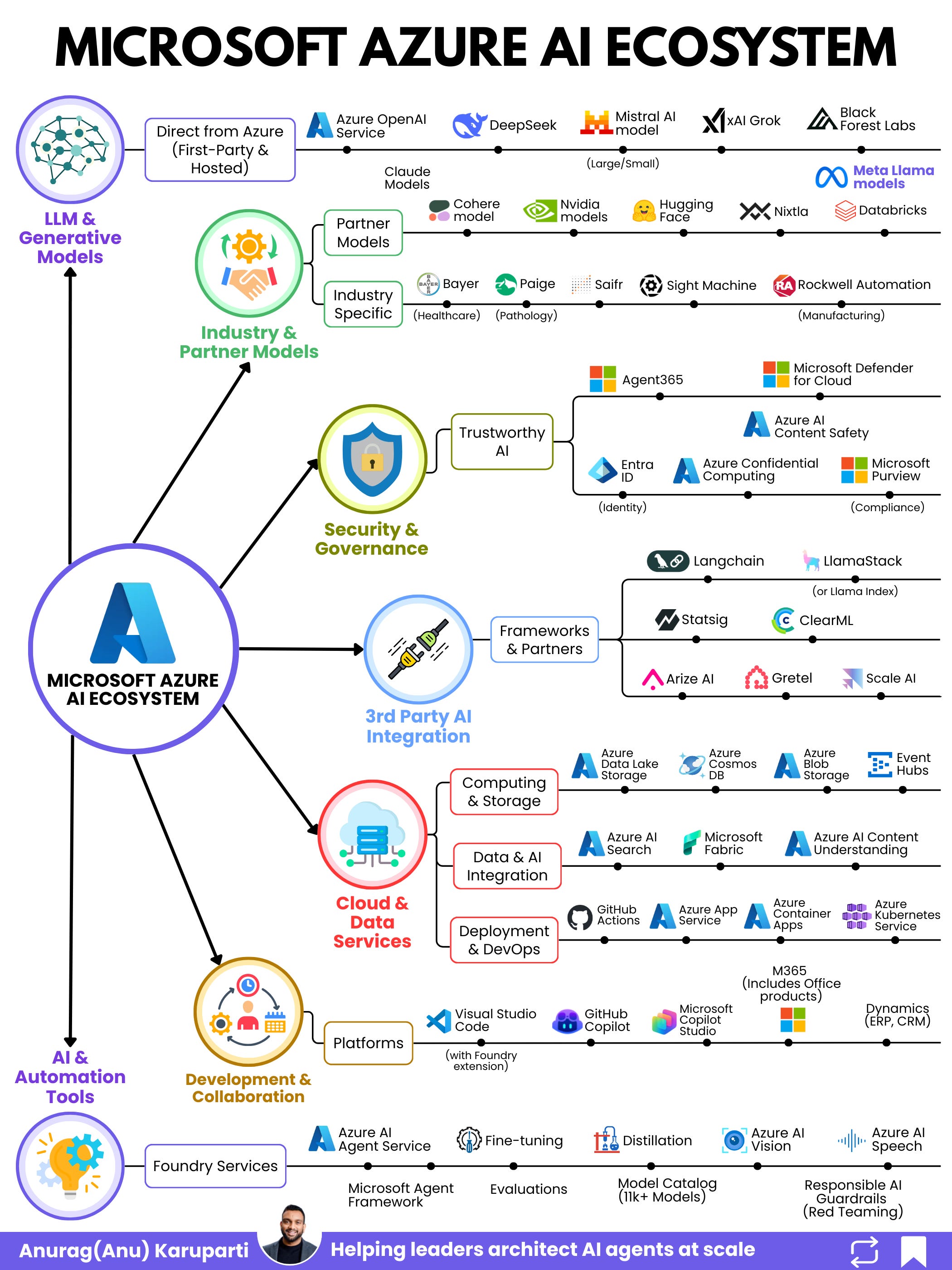
Breaking down Microsoft’s AI Ecosystem
When people ask me “What tools should we use for Enterprise AI?”, my answer is always the same: the answer is not one tool. It is an ecosystem. Here is the complete Microsoft Azure AI stack, layer by layer.
1. LLM & Generative Models
Choice without chaos. Microsoft gives you the full spectrum of models under one governed roof.
Direct from Azure: Azure OpenAI Service, DeepSeek, Mistral AI (Large/Small), xAI Grok, Black Forest Labs.
Partner models from Claude, Cohere, Nvidia, Hugging Face, Nixtla, Databricks. And critically for regulated industries,
industry-specific models built for Healthcare (Bayer), Pathology (Paige), Manufacturing (Saifr, Sight Machine, Rockwell Automation).
The insurance CTO does not have to choose between capability and compliance. She can have both.
2. Security & Governance
Entra ID for agent identity, Azure Confidential Computing for data-in-use protection, Microsoft Purview for compliance, Azure AI Content Safety to build safe AI, and Microsoft Defender for Cloud to protect the endpoints.
The CISO’s question finally has a defensible answer.
Trustworthy AI is not a feature. It is a foundation. This is where Microsoft’s moat is most visible to enterprise buyers.
3. 3rd Party AI Integration
Microsoft is not building walls. The best open-ecosystem tools plug in natively, because enterprises rarely start from zero. They have existing investments, and Microsoft meets them where they are.
Most enterprises have data scattered across AWS S3, on-prem warehouses, and legacy systems. For example, with Fabric Shortcuts, your data stays exactly where it is. Microsoft runs analytics and AI directly on top of it, no migration required. Thus building a unified data estate and breaking silos.
The data layer is where most AI projects quietly die. Microsoft solves this with a complete production lifecycle in one governed stack.
4. Cloud & Data Services
Computing and Storage: Data Lake Storage, Cosmos DB, Blob Storage, Event Hubs.
Data and AI Services: Azure AI Search for Agentic RAG, Microsoft Fabric for Analytics and unified data estate, Azure AI Content Understanding for advanced data extraction from documents.
Deployment and DevOps: GitHub Actions, Azure Devops, Azure App Service, AKS, Azure Container Apps.
5. Development & Collaboration
VS Code with extensions like GitHub Copilot, Claude Code, and Codex has quietly become the most powerful IDE for building enterprise software.
Combined with deep Azure integrations, you no longer need to memorize SDK documentation or worry about boilerplate integrations. With deep integrations with Github, CICD means just few prompts for your agents.
The coding agents handle that. I have been building full applications in plain natural language inside VS Code, and honestly, the dopamine hits are real.
This is what the future of enterprise software development feels like.
6. AI & Automation Tools: Copilot Studio + Foundry Services
The intelligence layer that ties it all together. This is where your agents, models, and automations live and scale in production.
Copilot Studio for low code agent building + deeper integrations, higher flexibility and model choice (10,000+ models) with Foundry.
7. Publish and Deploy on Work Products (M365)
The agents built on Foundry and Copilot Studio can be published to Teams or sharepoint, making it easier for business users to interact with agents on the interface they are familiar with without switching it.
8. Microsoft’s Chip Infrastructure
Most enterprises assume Microsoft just runs on Nvidia GPUs. The reality is more interesting. Microsoft has been quietly building its own silicon. Azure Maia 100 was Microsoft's first in-house AI accelerator, designed specifically to run large-scale cloud AI workloads like Microsoft Copilot. Microsoft Azure They did not stop there.
The new Maia 200, built on TSMC's 3nm process, is purpose-built for AI inference and delivers 30% better performance per dollar than the previous generation hardware in their fleet.
Microsoft's integrated model, combining chips, AI models, and applications, creates a competitive advantage because they can tightly align chip design, model development, and application-level optimization in ways no one else can. Microsoft EMEA When you own the silicon, the software, and the surface layer, the economics of running AI at enterprise scale shift dramatically in your favor.
So the big question: What Is Microsoft’s Real Moat?
Five things. And none of them are about having the best single LLM model.
1. Ecosystem Depth No One Can Replicate Overnight:
Azure, GitHub, Office 365, Teams, Dynamics, Power Platform were not built for AI. But they were built. And now AI runs through all of them. The integration surface area a competitor would need to match this took 20 years to construct.
2. Native Integrations That Eliminate the Glue Layer
Every enterprise AI project I have seen fail had the same root cause: too much custom plumbing between tools that were never designed to talk to each other. Microsoft’s tools share the same identity, data contracts, and monitoring surface. That is a 6-month head start on every production deployment.
3. Agent Governance at Enterprise Scale with Agent 365
We are entering the era of AI agents that act autonomously: booking meetings, triggering workflows, moving money. Governing them is the unsolved problem keeping CISOs and CFOs up at night. Agent 365 gives enterprises the control plane: policy enforcement, cost visibility, audit trails, and behavioral guardrails across every agent in the estate. No other vendor has this at scale.
4. Enterprise Security Woven Into the Architecture, Not Added After
AI systems are a new attack surface: model poisoning, prompt injection, data exfiltration through inference. Microsoft’s security posture treats AI workloads as first-class security subjects.
Highly recommend reading about Red Teaming agent by Microsoft, that help safeguard your agents proactively against sophisticated prompt injection attacks.
5. Quantum-Safe Cryptography: Playing a Longer Game
Quantum computing will eventually break the encryption standards protecting AI infrastructure today. Microsoft is already developing post-quantum cryptographic standards because they understand the threat horizon extends well beyond the next product cycle. When that day comes, enterprises on Azure will not be scrambling to retrofit security. They will already be protected.
Closing Point
You might think I'm biased since I work at Microsoft. Fair point. But what I've laid out here are facts, not marketing. No single organization has built this depth of integration across models, security, data, developer tooling, and user surfaces. That is the moat. Judge it for yourself.