

In Part 1, I made the case that an AI CoE = Platform + People + Patterns. In Part 2, I broke down why Platform is the non-negotiable foundation. In Part 3, I explained why People are your force multiplier.
Now in the final part, let’s talk about the third pillar: Patterns - your moat for outpacing competitors, multiplying value, and turning AI investments into measurable ROI.
Everyone obsesses over platforms and people. Pick the right LLM. Hire the right ML engineers. Build the right team structure.
Sure, those matter. But here’s the truth serum nobody wants to hear:
Platforms give you the rails. People supply the horsepower. Patterns are the operating system.
Without patterns, you’re just running expensive science projects at enterprise scale. That’s not innovation. That’s chaos with a bigger cloud bill.
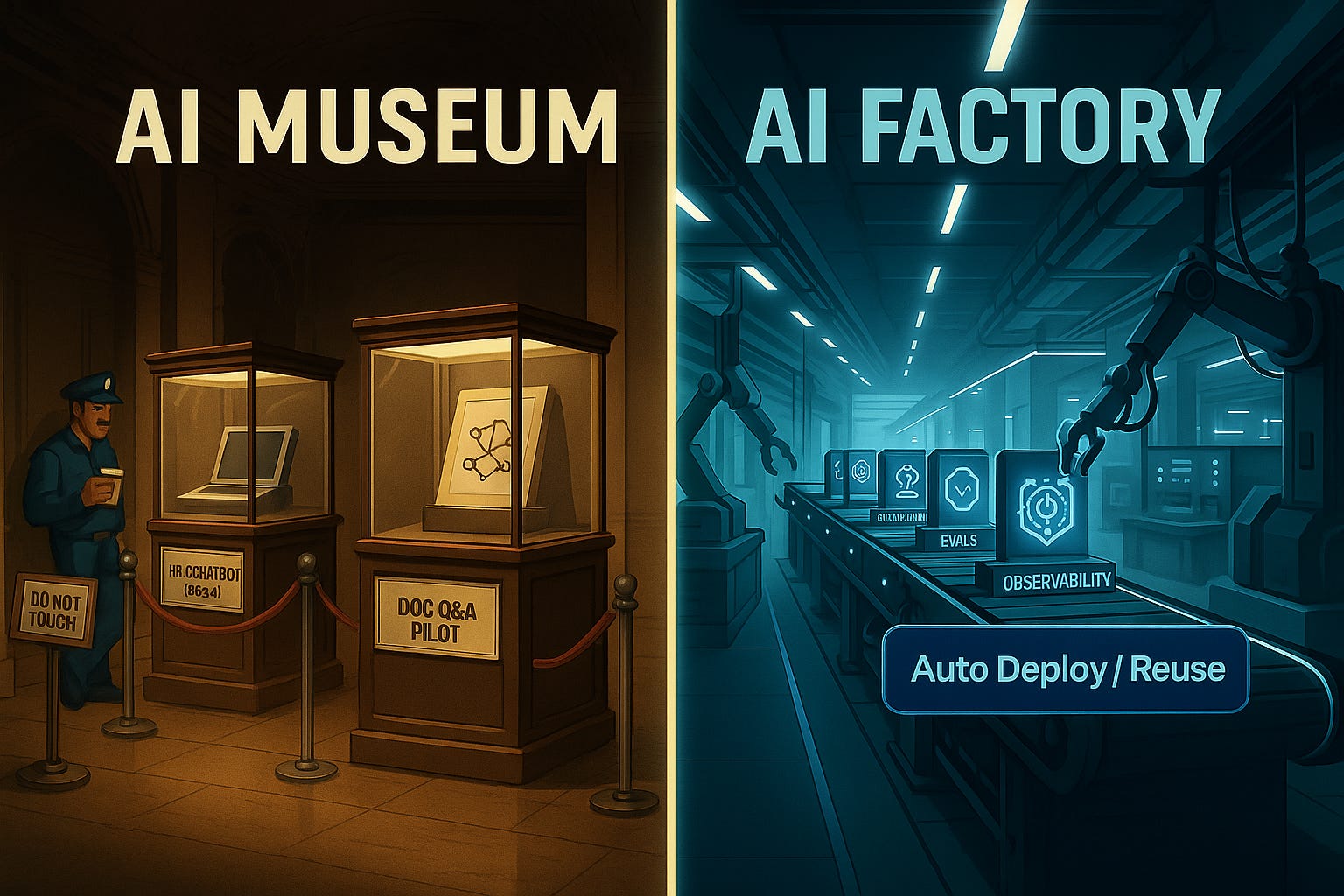
The AI Museum Problem
Most organizations follow the same tragic arc.
It starts innocently. Someone builds a shiny HR chatbot. Another team ships a document Q&A proof-of-concept.
Then a staff engineer gets excited about GraphRAG after a conference talk, and suddenly you have three different architectures built by three teams who’ve never spoken to each other.
Six months later, you wake up and realize the uncomfortable truth: you didn’t build an AI strategy. You built a museum of AI experiments.
Each exhibit has a plaque explaining what the team hoped to accomplish. None of them talk to each other. Most are gathering dust. And every time someone asks “can we reuse this?” the answer is a 47-minute explanation of why this use case is totally different.
Sound familiar?
Patterns Fix That
Patterns are your reusable decision DNA. They’re the difference between every team solving authentication from scratch and everyone importing the same battle-tested auth library.
Good patterns force discipline. They remove vibes-based architecture decisions. They let a $200k engineer ship like a $600k one because they’re not reinventing the wheel. They’re assembling proven components that already work.
Patterns make “we should scale this” an actual sentence you can act on, not a vague aspiration that dies in the next quarterly review.
1. What Great AI Patterns Actually Look Like
Golden Paths
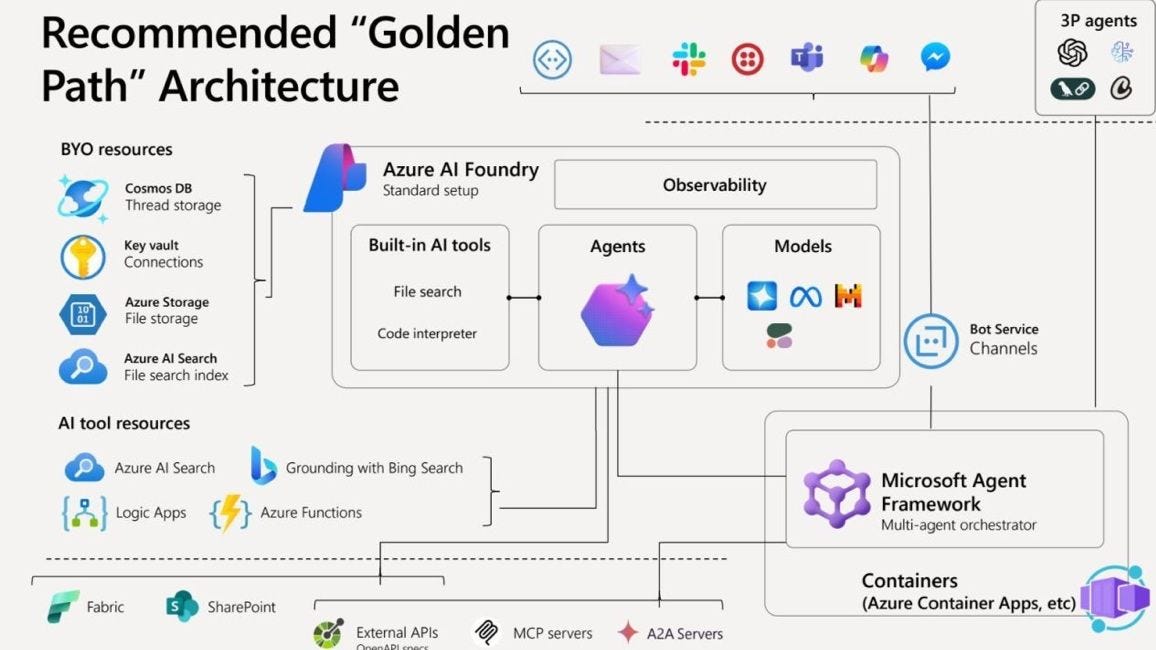
Think of these as battle-tested blueprints for the problems you’re actually solving like chat interfaces, document intelligence systems, multi-agent workflows. Not theoretical frameworks or academic exercises, but practical implementations that have survived the harsh realities of production environments.
Take this golden path architecture for agentic applications that Microsoft’s product team recently released. It’s a perfect example of what I mean: real patterns from teams who’ve shipped real products. I’ll dive deeper into this architecture in my next post.
Reference architecture
Guardrails Baked In
Evals, safety checks, compliance logging, observability hooks. Not a slide deck you show leadership. Not a “we’ll add that later” backlog item. A non-negotiable baseline that ships with every pattern. If it can’t pass these checks, it doesn’t ship.
Azure AI Landing Zones which I mentioned in Episode 2, provides exactly this kind of foundation - a strong security baseline that becomes non-negotiable for every pattern you ship.
Lifecycle Discipline
Patterns get versioned. They get reviewed. They get retired. If your pattern library never sunsets anything, you’re not maturing your AI practice. You’re hoarding legacy debt. The graveyard of deprecated patterns is a sign of health, not failure.
Take basic RAG applications. They’re evolving into agentic RAG systems that deliver higher accuracy and better contextual responses. Basic RAG gets retired to the graveyard unless it’s still enabling your specific use case with high accuracy. That’s discipline, not waste.
Infrastructure and Policy-as-Code
Governance stops being a gate and becomes code. Reproducible. Auditable. Fast. Drama-free.
When someone spins up a new AI service, compliance happens automatically because it’s baked into the pattern, not bolted on through a separate approval process. Use infrastructure-as-code tools like Terraform and Bicep to encode your policies directly into your deployment pipelines.
2. The Mindset Shift
Here’s what changes when you embrace patterns:
The best AI Centers of Excellence don’t operate like ivory tower committees. They operate like open-source maintainers.
Patterns evolve in public (or at least, in the open within your org). Bad patterns die fast. Good patterns scale everywhere. Everyone builds from the same mental model.
There’s no mystery. No tribal knowledge. No “you had to be in that meeting” context. Just clear, tested, documented patterns that anyone can pick up and run with.
This is how you move from slideware strategy to real AI compounding. This is how you stop having the same architecture debates in every project kickoff. This is how a 50-person AI team starts shipping like 200.
3. Ship Patterns. Not Just Pilots.
Every company has pilot fatigue right now. Another RAG demo. Another chatbot POC. Another “let’s see what this can do” experiment.
What they don’t have enough of? Reusable patterns that turn those pilots into production systems.
Your job isn’t to prove AI works. Everyone knows it works. Your job is to make it work repeatably. At scale. Across teams. Without re-litigating every architectural decision.
Build your patterns. Evolve them. Sunset the ones that don’t serve you. And watch what happens when your entire organization can ship AI features as easily as they ship any other code.
That’s not just efficiency. That’s your moat.
This will turn your AI museums to AI factories with repeatable patterns.
If you found this useful, support my work by following Diary of an AI Architect on Substack and Linkedin, where I share practical playbooks, architectures, and insights to help you turn AI hype into enterprise reality.