

Claude recently released finance-focused agents. Also agents for small businesses.
That caught my attention because it signals something bigger than one product launch: agents are starting to specialize by vertical.
The more I look at this shift, the more I keep coming back to one question:
Finance agents. Coding agents. Research agents. Customer support agents. Healthcare agents. Commerce agents.
What happens when AI agents stop being general assistants and start becoming domain specialists that make decisions on our behalf
This week, I wanted to dig into one vertical where that change could be massive: retail.
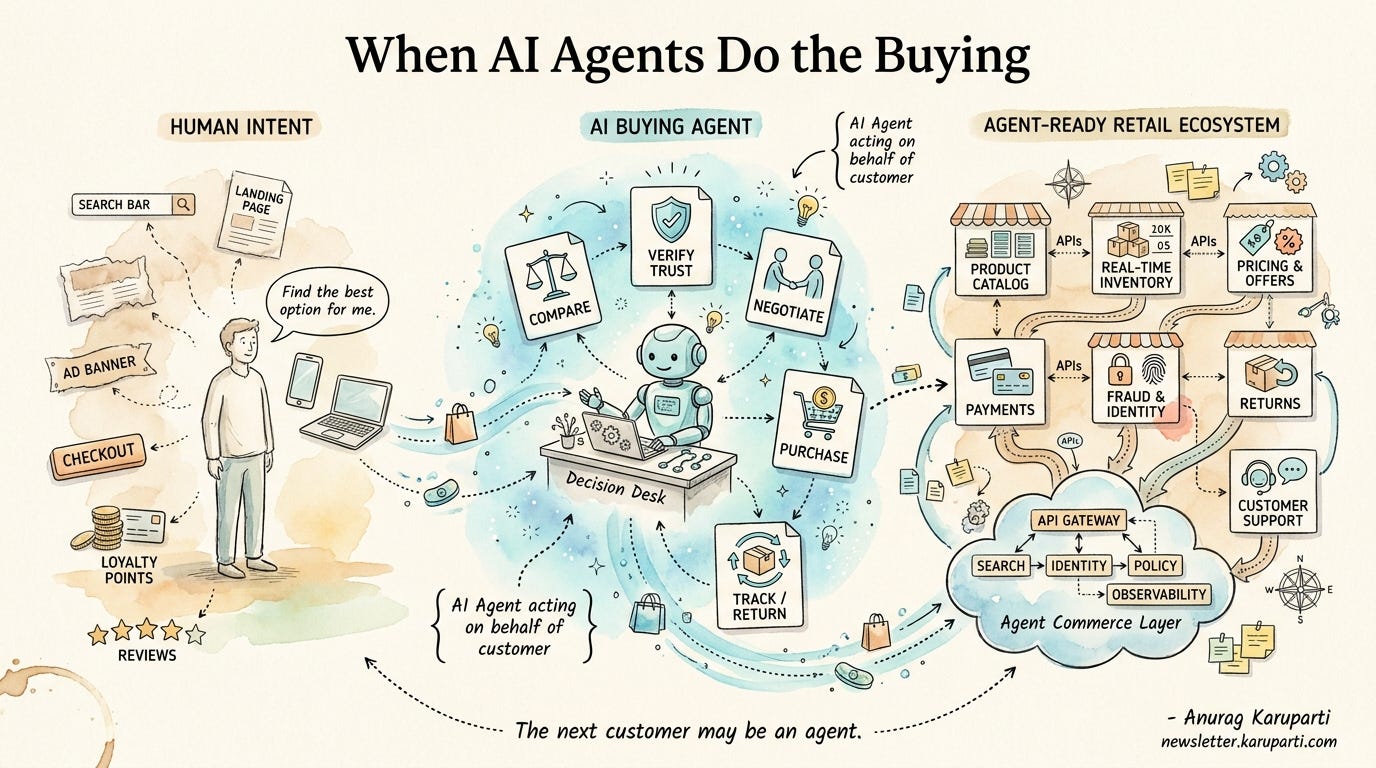
Because retail has always been designed around human behavior.
Clicks. Search bars. Landing pages. Promotions. Reviews. Checkout flows. Loyalty points. Retargeting ads.
But what happens when the customer is no longer the one doing the browsing?
What happens when the customer simply says, “Find the best option for me,” and an AI agent does the comparing, negotiating, purchasing, tracking, and returning?
That is the question I have been trying to understand:
**How will customers shop when AI agents do the buying?**
Most businesses are still optimizing for human shoppers.
Better landing pages. Better funnels. Better ads. Better checkout buttons. Better retargeting.
But the next commerce interface may not be a person clicking through your website.
It may be an AI agent acting on behalf of that person.
That sounds futuristic until you realize the building blocks are already here: computer-use agents, agent communication protocols, API-first commerce platforms, AI search, payment orchestration, fraud detection, and identity systems.
The real question is not whether AI agents will influence shopping.
The real question is whether your business is ready to be understood, compared, trusted, and transacted with by agents.
The shopping journey is about to change
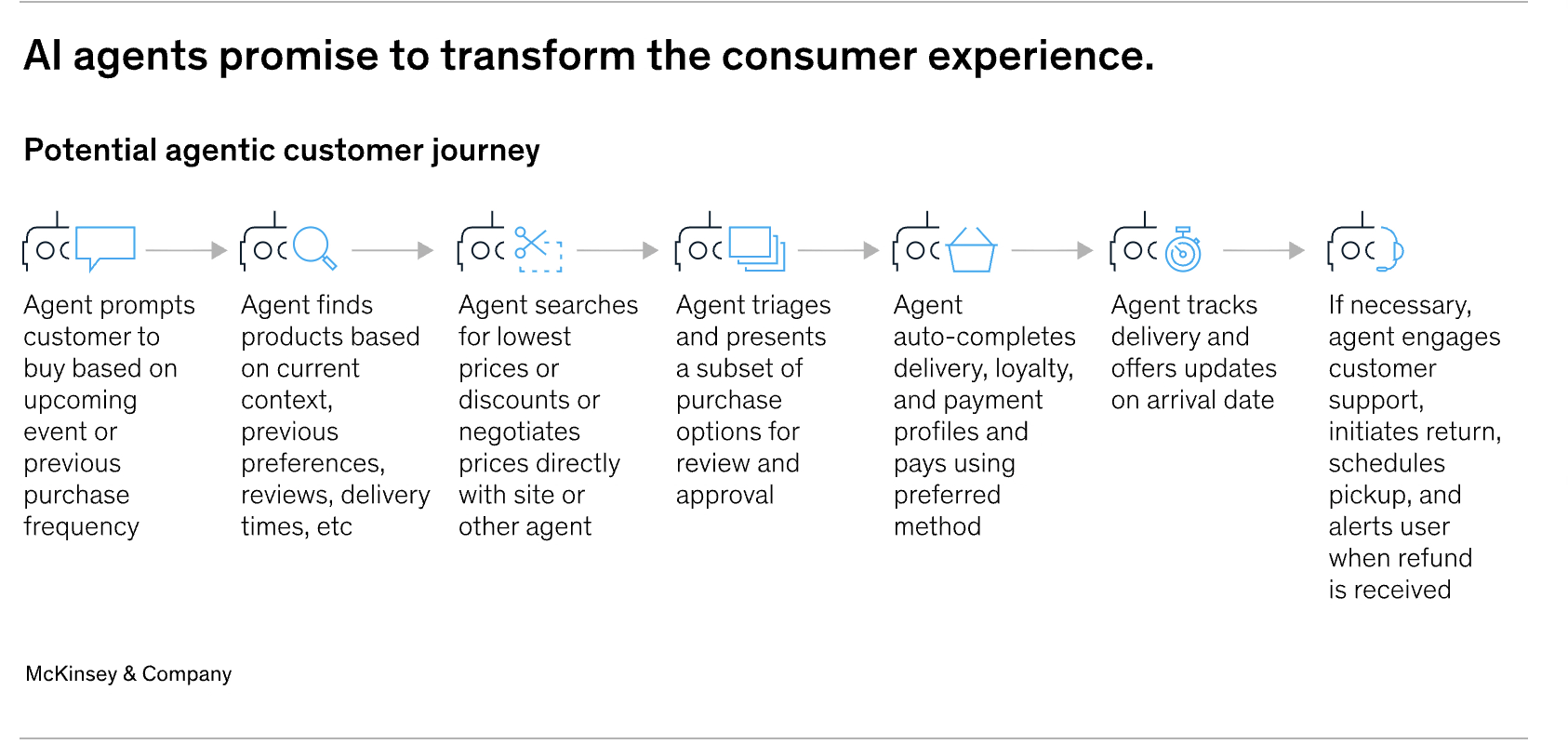
Picture Sarah, a VP of Product at a healthcare company.
She needs to book a business trip to Chicago. Today, that means opening six tabs: airline, hotel, credit card rewards, maps, restaurant reservations, and the company travel policy.
She compares prices. Checks points. Reads reviews. Looks for cancellation rules. Books dinner. Saves receipts.
Now imagine Sarah saying this instead:
Book my Chicago trip. Keep it under policy. Prioritize hotels near the board office. Use loyalty points only if the redemption value is good. Book dinner for four people on Tuesday. Ask me before final purchase.
Her AI agent handles the work.
It checks travel policy. Compares hotels. Reviews loyalty benefits. Looks at cancellation terms. Books dinner. Creates the itinerary. Then asks Sarah to approve the final transaction.
Sarah does not browse.
Sarah delegates intent.
That is the shift.
When customers delegate intent, commerce moves from human navigation to agent execution.
And that changes the architecture.
As per McKinsey research, by 2030, the US B2C retail market alone could see up to $1 trillion in orchestrated revenue from agentic commerce, with global projections reaching as high as $3 trillion to $5 trillion
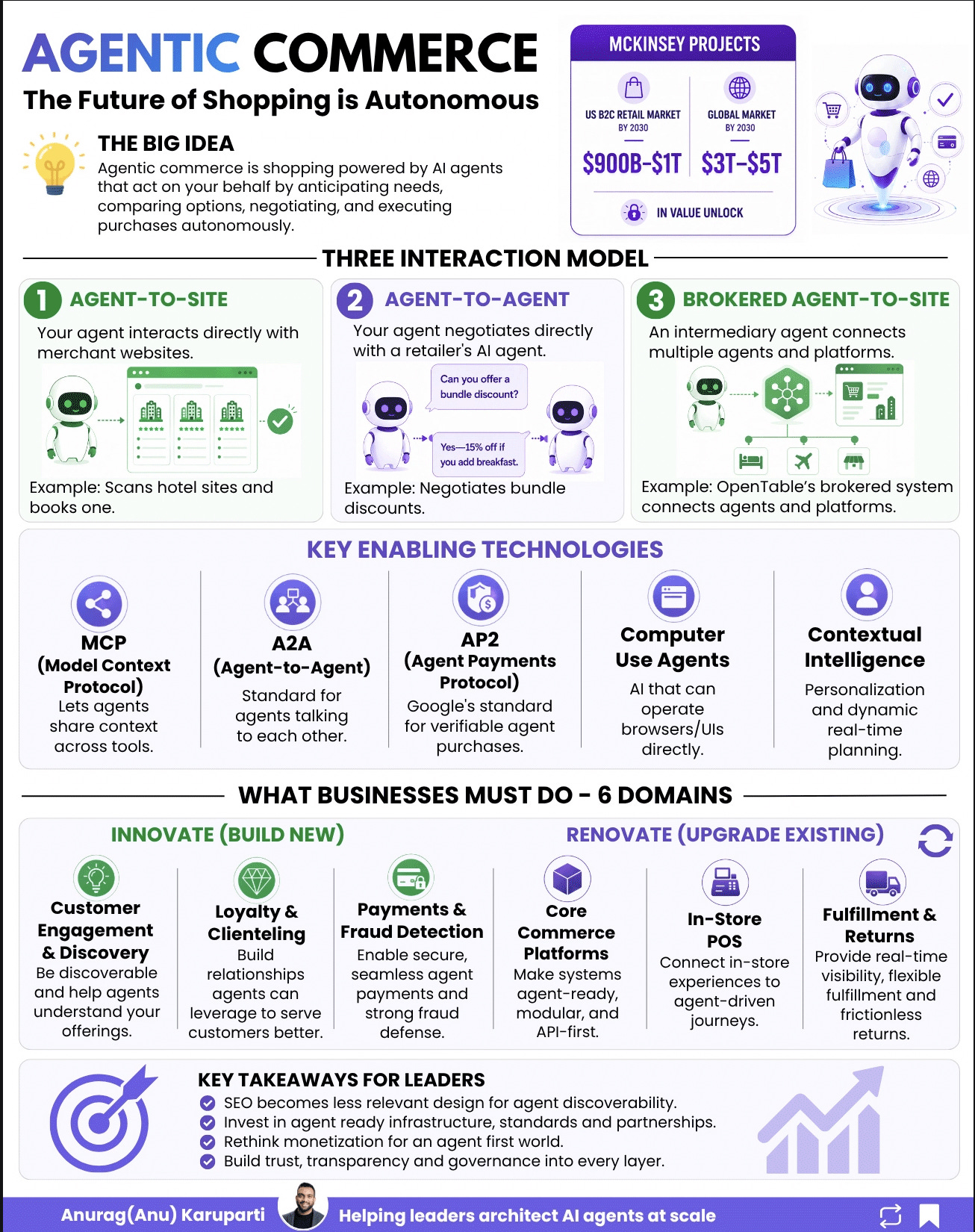
If this mental model above gave you clarity on Agentic concepts,
I built a 74 visual AI library with animated guides that take you from agent basics to production grade architectures.
Agents. Agentic RAG.Multi agent orchestration.Enterprise governance. Production patterns.
Used by architects, engineers, and executives. 3 million plus impressions on Linkedin.
Built for fast clarity before meetings, interviews, and real world builds.
The six building blocks accelerating agentic commerce
The rapid pace of innovation in agentic AI is not coming from one model release.
It is coming from a stack of tools and protocols that make agents more useful, interoperable, and commercially actionable.
Here are the six developments I am watching most closely.
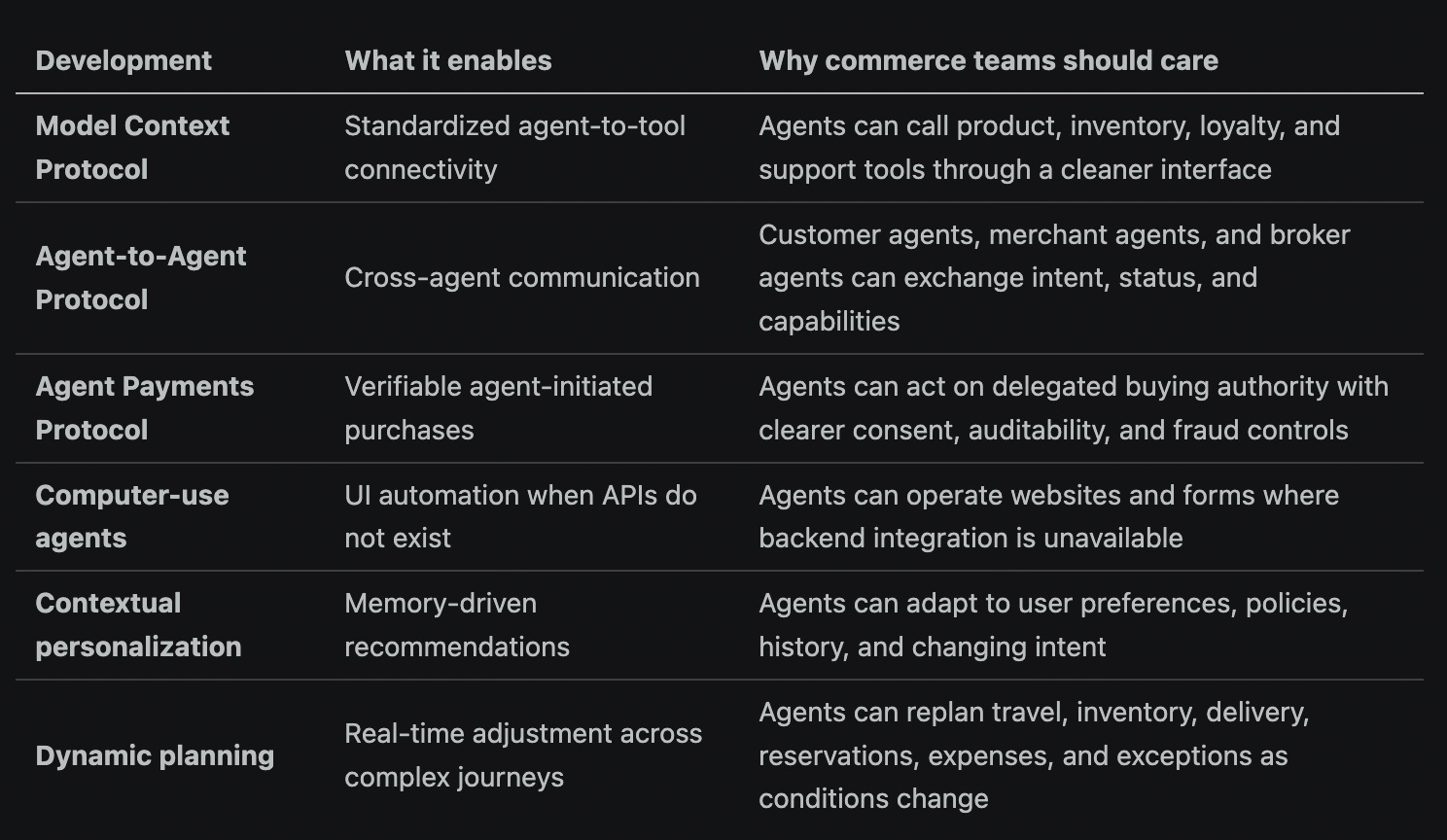
Model Context Protocol, or MCP, matters because agents need more than prompts.
They need a standardized way to connect to tools, retrieve context, call functions, and operate across systems. In commerce, that means an agent can check inventory, apply a loyalty rule, retrieve a return policy, or create a support case without every team building a custom integration from scratch.
Agent-to-Agent Protocol, or A2A, matters because commerce will not be one agent talking to one website forever.
Customer agents will negotiate with merchant agents. Broker agents will compare options across many providers. Partner agents will coordinate fulfillment, payment, and service recovery. For that to work, agents need a shared interaction model for exchanging capabilities, task status, context, and multimodal outputs across vendors and environments.
Agent Payments Protocol, or AP2, is one of the clearest signs that agentic commerce is moving from demo to transaction layer.
The important idea is the mandate. A mandate connects user intent, cart details, and payment authorization into a verifiable audit trail. That matters because autonomous purchases need accountability. Merchants need to know the agent had authority. Users need limits and revocation. Payment networks need fraud controls. Enterprises need evidence.
Computer-use agents fill the gap when APIs are missing.
An agent that can use a browser, click buttons, fill forms, and navigate a user interface can automate workflows that were never designed for agent access. This will be messy, fragile, and hard to govern at scale, but it is useful in niche domains where building a formal API is not economical.
Contextual AI-driven personalization changes recommendations from static search results to adaptive intent handling.
Instead of asking, “What did this user click last week?” the system starts asking, “What is this person trying to accomplish right now, given their history, constraints, preferences, and current context?” That is where memory architectures, preference stores, vector search, and policy-aware personalization become important.
Dynamic planning with real-time adjustment is what makes the Sarah travel example possible.
The agent does not just book a flight. It coordinates flights, hotels, restaurants, calendar constraints, loyalty programs, approvals, expense systems, and backup options. If the flight changes, the itinerary changes. If the hotel sells out, the agent replans. If an expense crosses policy, the workflow asks for approval.
That is the big shift.
Agentic commerce is not only about smarter recommendations. It is about systems that can understand intent, coordinate tools, transact safely, and adjust plans in real time.
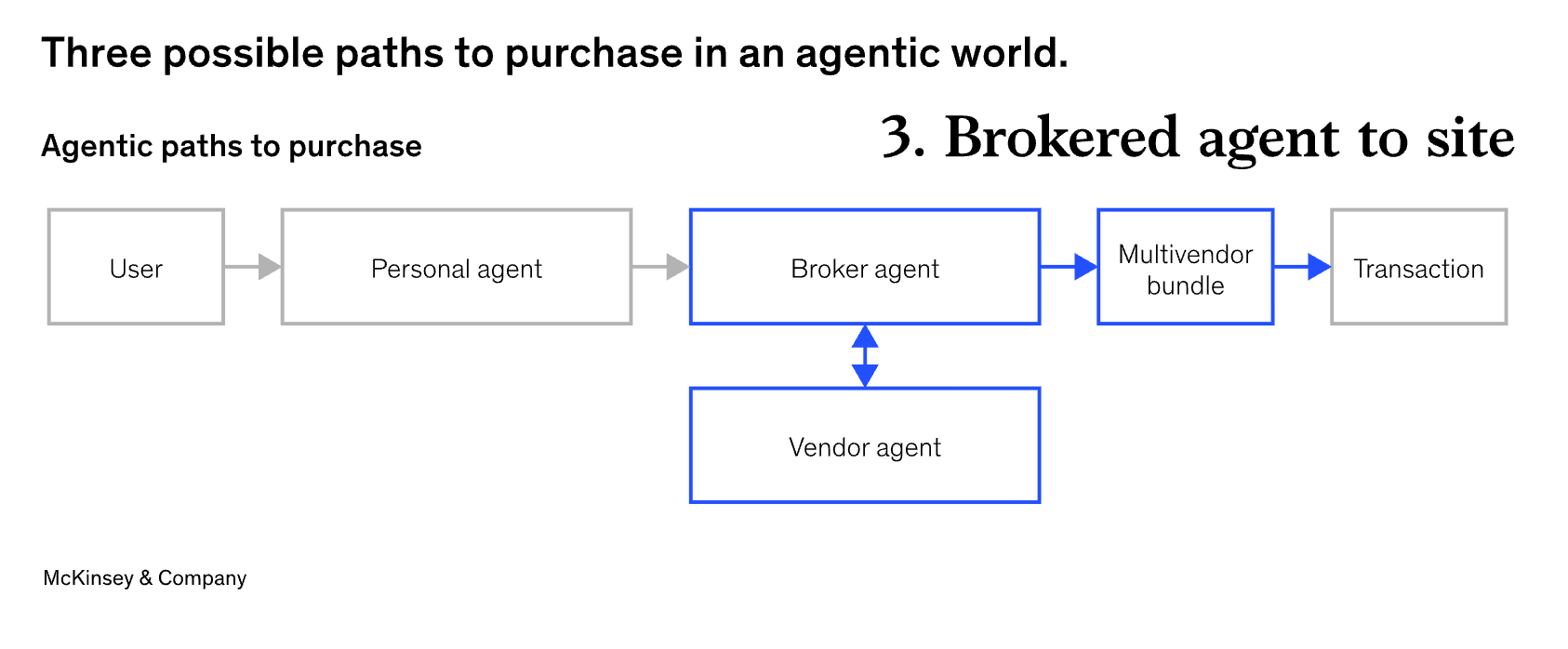
The three ways agents will interact with your business
I think about agentic commerce through three interaction models.
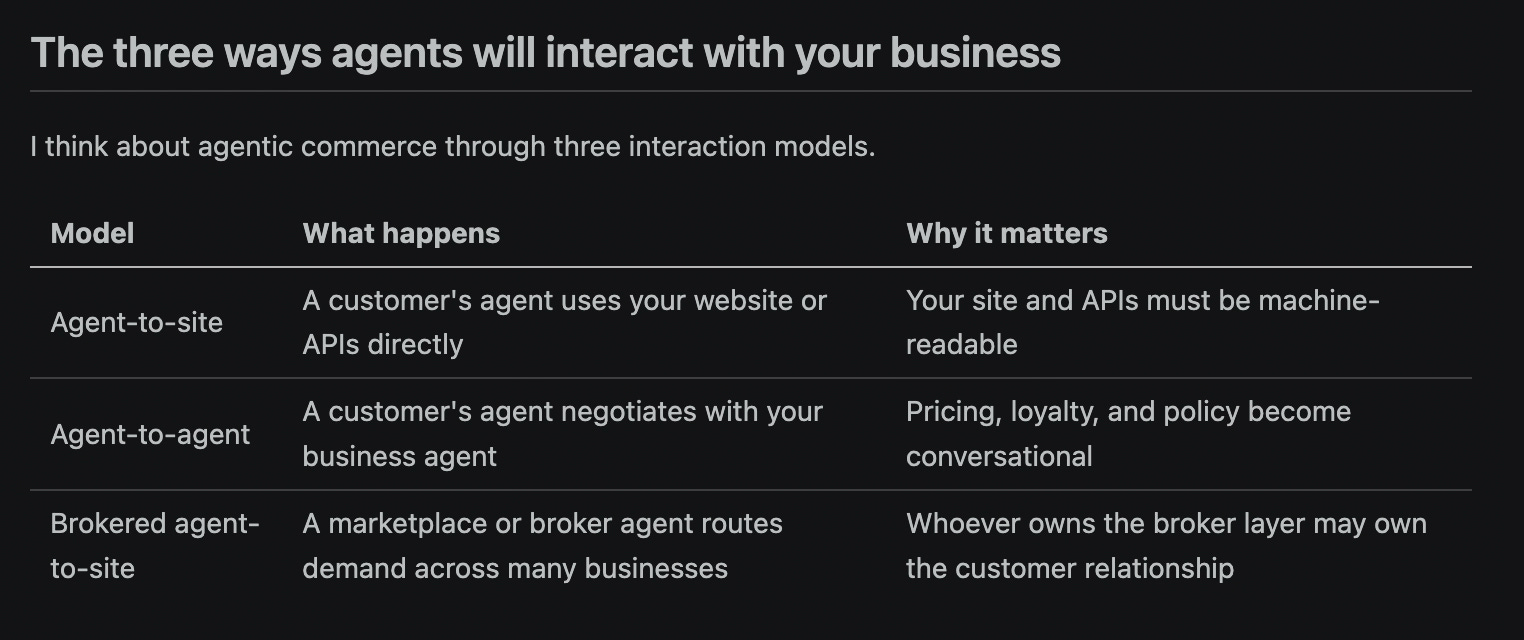
1. Agent-to-site
This is the simplest model.
A customer’s AI agent visits your website, scans your catalog, compares prices, checks policies, and completes checkout.
This may happen through browser automation, public APIs, structured product data, or a combination of all three.
The key point: your website is no longer only a human experience. It becomes a machine-readable decision surface.
If your inventory, pricing, cancellation rules, loyalty benefits, and delivery promises are hard for an agent to interpret, you are already behind.
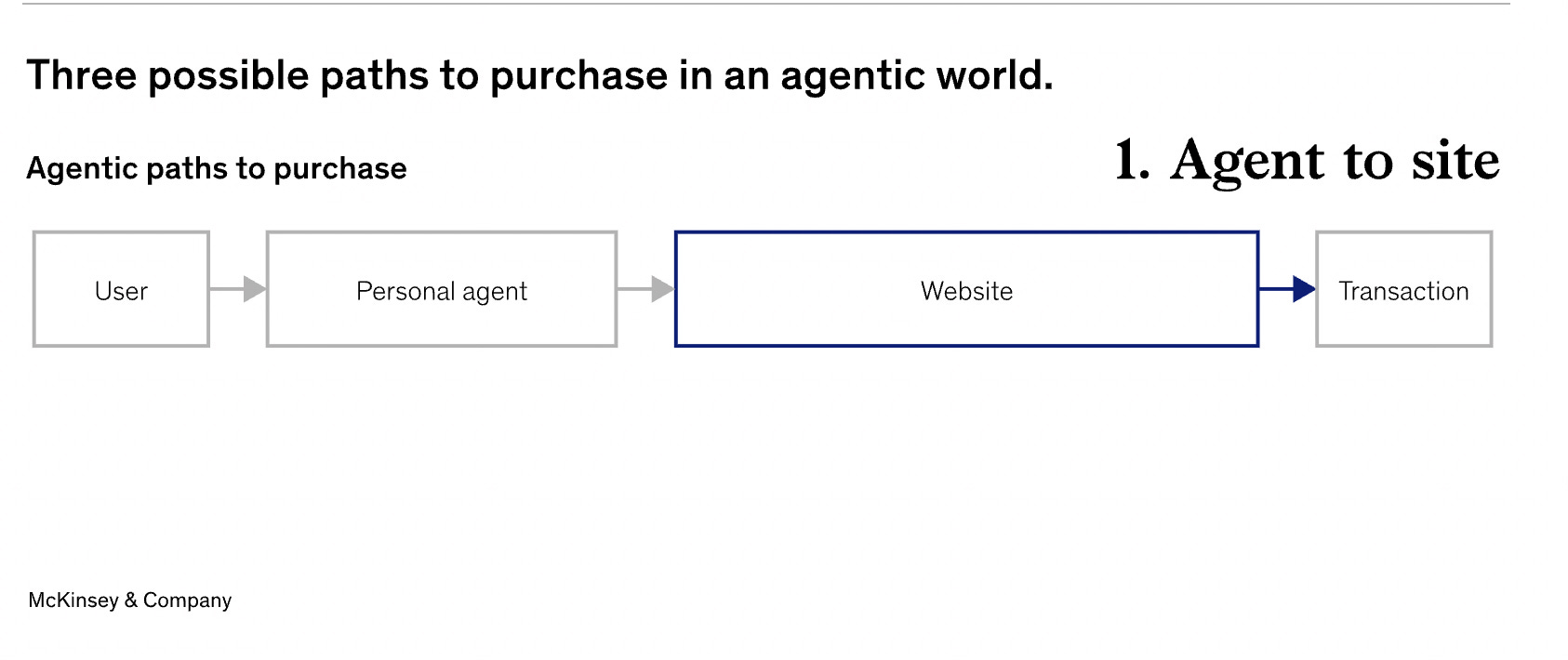
2. Agent-to-agent
This is where commerce gets more interesting.
Instead of a customer’s agent scraping your website, it talks directly to your business’s agent.
The customer agent says:
I need a hotel near downtown Chicago for three nights. My traveler has Gold status. Can you improve the offer if they add breakfast?
Your business agent responds:
Yes. I can offer 12% off if breakfast is bundled and the reservation is prepaid.
That is not a chatbot. That is a commerce negotiation layer.
It requires access to inventory, pricing, loyalty, margin rules, fraud signals, payment authorization, and business policy.
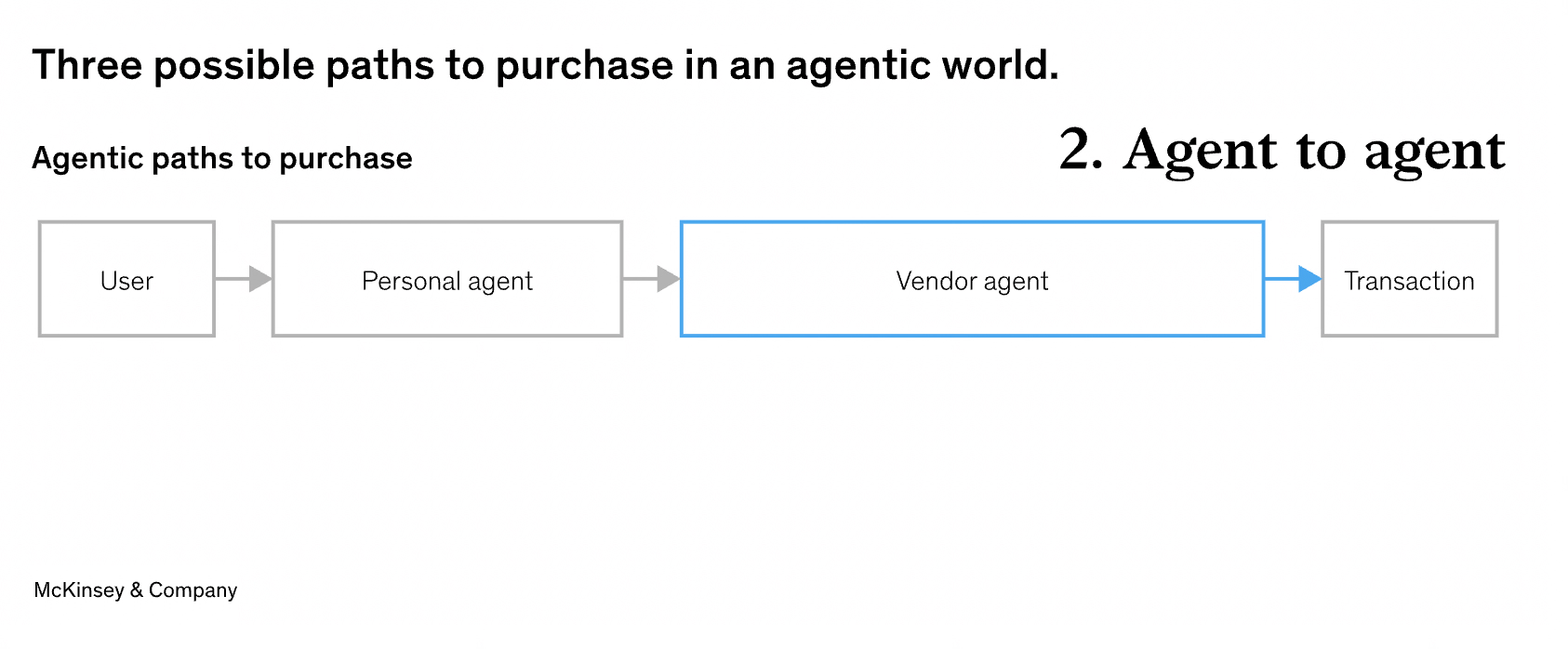
3. Brokered agent-to-site
This is the model every executive should pay attention to.
A broker agent sits between the customer and many businesses. It compares options, ranks them, and recommends a purchase.
Think OpenTable, Expedia, or Instacart, but generalized across more categories and powered by agents.
If the broker owns the customer interface, your business becomes one option inside someone else’s ranking system.
That ranking system may care about price, availability, reliability, refund flexibility, fulfillment confidence, and API quality.
What businesses need to build
Agentic commerce is not just a marketing channel.
It is an infrastructure shift.
Here are the six domains I would audit first.
1. Agent discoverability
Your products and services need to be discoverable by agents, not just humans.
That means structured catalogs, clear metadata, real-time availability, readable policies, and APIs, MCPs that expose what agents need to evaluate your business.
SEO does not disappear, but it changes.
The question becomes: can an agent confidently understand when your offer is the best fit for a customer’s intent?
2. Loyalty and clienteling
Most loyalty systems were built for humans checking points in an app.
Agents need something different.
They need to query loyalty status, unused rewards, customer preferences, tier benefits, personalized offers, and redemption rules.
If your loyalty program is trapped behind a human-only mobile interface, agents will ignore it.
If your loyalty system exposes secure, permissioned APIs, agents can use it to make better decisions for the customer.
3. Secure payments and fraud defense
This is the hardest part.
It is one thing for an agent to recommend a product. It is another thing for that agent to spend money.
Agentic commerce needs payment mandates that answer:
Who authorized this agent?
What is the spending limit?
What categories are allowed?
When is human approval required?
How does the merchant verify authority?
What happens if the agent makes a mistake?
A simple mandate might look like this:
{
  "agent_id": "travel_agent_789",
  "customer_id": "customer_123",
  "allowed_category": "business_travel",
  "max_transaction_amount": 1200,
  "approval_required_above": 500,
  "valid_until": "2026-06-30",
  "purpose": "Chicago board meeting"
}
That object is not just payment data.
It is identity, consent, policy, and fraud control in one package.
4. API-first commerce platforms
If core commerce actions are trapped inside a front end, agents will struggle.
Search, cart creation, pricing, promotions, checkout, order status, returns, and support escalation need clean APIs.
The architectural shift is from website-first commerce to capability-first commerce.
The website becomes one client.
Agents become another.
5. Connected in-store POS
Agentic commerce will not stay online.
A customer agent may reserve a product, apply a loyalty benefit, pre-authorize payment, and schedule pickup.
When the customer arrives in store, the POS needs to understand that journey.
If the online agent journey and the physical store system are disconnected, the experience breaks at the handoff.
6. Real-time fulfillment and returns
Agents will not only buy. They will track, change, cancel, return, and escalate.
That requires real-time visibility into orders, inventory, shipping, store availability, replacement options, and return eligibility.
In agentic commerce, operations become part of the product.
A bad fulfillment API can cost you the sale before a human ever sees your brand.
Highly recommend reading this Mckinsey paper on Agentic Commerce
The bottom line
Agentic commerce changes the buyer interface from clicks to delegated intent.
Your next customer may still be human, but the thing doing the shopping may be an agent.
The brands that win will not only have better marketing. They will have APIs, payments, loyalty systems, inventory, fraud controls, and fulfillment workflows that speak fluent agent.
♻️ If this was useful, share it with someone building with AI.
✉️ Subscribe at newsletter.karuparti.com so you never miss an edition.
P.S. Want more? 👋
1/ My visual guide to agentic AI → Gumroad
2/ Deep dives on agentic AI architecture → LinkedIn
3/ Real-time takes on breaking AI news → X
4/ Casual hot takes and community → Threads
5/ Visual frameworks and carousels → Instagram
6/ 60-second production lessons → TikTok
7/ The full newsletter, free → newsletter.karuparti.com
References
McKinsey - https://www.mckinsey.com/capabilities/quantumblack/our-insights/the-agentic-commerce-opportunity-how-ai-agents-are-ushering-in-a-new-era-for-consumers-and-merchants
Google Agent2Agent protocol announcement: https://developers.googleblog.com/en/a2a-a-new-era-of-agent-interoperability/
Google Agent Payments Protocol announcement: https://cloud.google.com/blog/products/ai-machine-learning/announcing-agent-payments-protocol-ap2
Disclaimer: The stories and scenarios in this article are hypothetical, inspired by patterns observed across similar real-world experiences. They are used to convey key concepts more effectively and do not represent any specific individual or organization.